:+86-13726207043
:info@yuxun.com
- All
- Product Name
- Product Keyword
- Product Model
- Product Summary
- Product Description
- Multi Field Search

Views: 212 Author: YUXUN CABLE Publish Time: 2026-06-21 Origin: Site


Content Menu
● What Optical Fiber Really Is (From an Engineer's Perspective)
● Optical Fiber vs. Copper: What Actually Changes in Real Deployments?
● Advantages and Limitations: Honest Technical View
>> Key Technical Advantages of Optical Fiber
>> Practical Disadvantages You Must Plan For
● Top Application Domains for Optical Fiber and High‑Speed Cables
>> Global Communication Systems and Data Centers
>> Medical and Biomedical Systems
>> Internet, FTTH, and Cloud Connectivity
>> Automotive and In‑Vehicle Networks
>> CCTV, Security, and Industrial Video
>> Industrial Inspection & NDT (Non‑Destructive Testing)
>> Military and Aerospace Systems
>> Space and Satellite Communication
>> Cable Television (CATV) and Broadcast Networks
● Where High‑Speed Copper Cables Still Matter
● Buyer Guidance: How Engineers Should Choose the Right Transmission Cable
● Why OEM/ODM Expertise Matters: Perspective From the Manufacturing Floor
● Expert Tips to Future‑Proof Your Cabling Strategy
● Practical Use Case Table: Matching Application to Cable Type
● Conclusion and Call to Action
● FAQs
Optical fiber and high-speed transmission cables have quietly become the backbone of every modern network I've helped design or optimize over the past decade, from hyperscale data centers to automotive and factory automation lines. As both an industry consultant and content strategist working with OEMs like Zhuhai Yuxun Innovation Technology Co., Ltd., I've seen how a clear, expert-level guide to fiber and high-speed cabling can directly influence buyer decisions and long-term system reliability. [fdgweb]
In high‑bandwidth projects—whether 400G data center upgrades, industrial PLC networking, or in‑vehicle infotainment—the most expensive mistake is choosing the wrong transmission cable. Optical fiber and modern high‑speed copper/hybrid cables solve this by combining massive bandwidth, low latency, and robust signal integrity when they're selected and deployed correctly. [jmtjm]
From my experience supporting global OEM and ODM customers, high‑speed cabling is not just a component; it is a strategic asset that defines scalability, uptime, and the total cost of ownership of the entire system. [connectorsupplier]
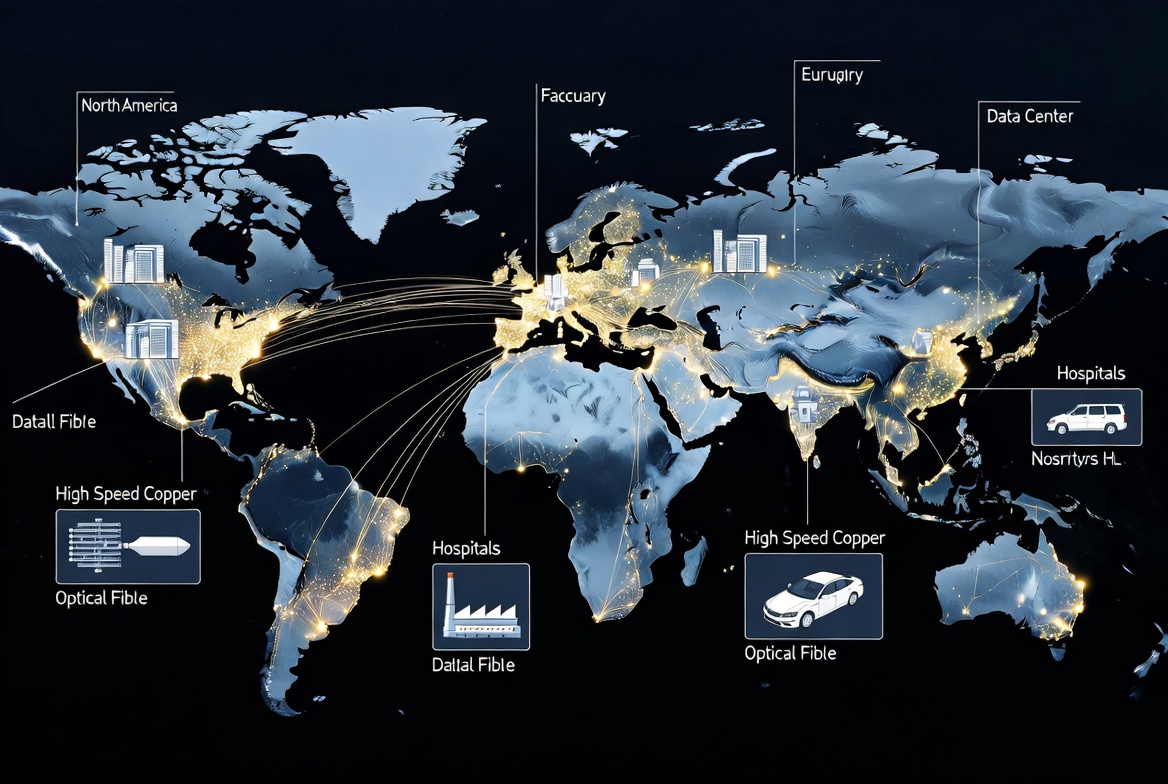
Optical fiber is a flexible, transparent waveguide made from silica, glass, or plastic that carries data as pulses of light via total internal reflection. Unlike copper, which transports electrical signals, fiber converts information into optical signals that travel through the core with extremely low loss and immunity to electromagnetic noise. [blog.samtec]
In practical projects, this means your backbone links can run for many kilometers with stable performance, making fiber ideal for telecom carriers, campus networks, and industrial parks where centralised control rooms sit far from edge devices. [fdgweb]
When buyers compare fiber with twisted‑pair or coaxial copper, they often focus just on speed—but in real deployments, several factors matter more. [jmtjm]
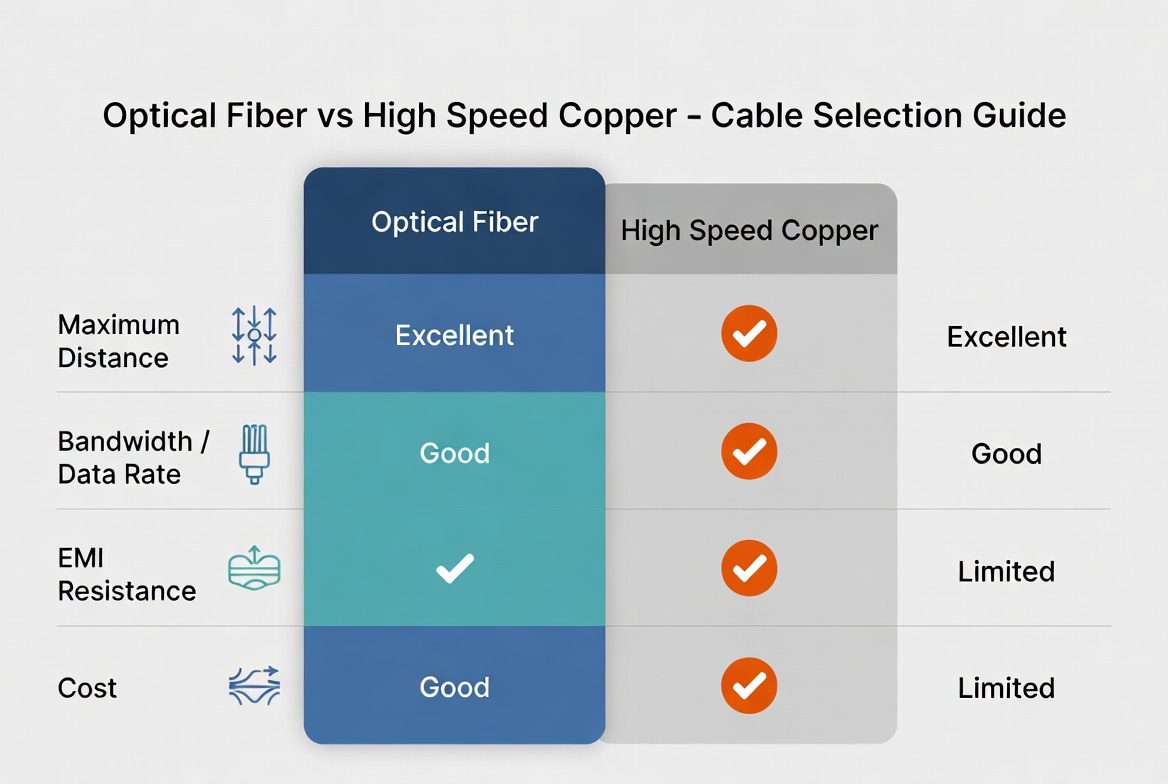
- Bandwidth and speed – Fiber supports extremely high data rates and dense wavelength division multiplexing (DWDM), enabling multi‑Tbps links where copper becomes impractical. [blog.samtec]
- Distance – Fiber can carry signals over tens of kilometers without heavy amplification, while copper links face serious attenuation at a few hundred meters for high‑speed standards. [fdgweb]
- EMI immunity – Fiber is immune to electromagnetic interference and crosstalk, which is critical in factories, power plants, and automotive environments. [connectorsupplier]
- Security – Optical links are harder to tap discreetly than copper, making them attractive for military, financial, and government networks. [fdgweb]
- Weight and diameter – Fiber cables are thin and lightweight, improving cable management and reducing payload in aerospace and automotive applications. [fdgweb]
From a project‑budget perspective, copper can be cheaper at short distances and low speeds, but once you design for gigabit‑class and beyond—especially in noisy environments—fiber and high‑speed shielded copper assemblies become the safer, more future‑proof investment. [jmtjm]
Real‑world deployments repeatedly confirm several non‑negotiable advantages of fiber. [fdgweb]
- Lightweight, thin form factor suitable for dense patch panels and harnesses. [fdgweb]
- High bandwidth with support for 1G–400G and emerging higher‑rate standards. [blog.samtec]
- Immunity to EMI and radio‑frequency interference. [connectorsupplier]
- Low attenuation and low latency over long distances. [fdgweb]
- Non‑combustible materials for improved fire performance in buildings. [fdgweb]
For OEM partners, these characteristics mean fewer field complaints, more predictable performance, and easier compliance with telecom and building‑safety regulations. [fdgweb]
However, fiber is not perfect, and ignoring its limitations can lead to project delays and rework. [fdgweb]
- Fragility – Glass fibers are more brittle than copper and require controlled bend radius and proper cable routing. [fdgweb]
- Specialized installation skills – Splicing, polishing, and termination need trained technicians and certified tools. [fdgweb]
- Initial cost – Active equipment and installation tooling can be more expensive up front, even though maintenance is lower. [fdgweb]
From the buyer side, the most successful deployments I've seen are those where integrators combine fiber backbones with short‑run high‑speed copper cables, balancing cost and performance while respecting each medium's constraints. [jmtjm]
Carrier networks, cloud facilities, and enterprise backbones depend on optical fiber plus high‑speed copper interconnects for core switching, storage, and server connectivity. [connectorsupplier]
Typical uses include: [connectorsupplier]
- Submarine fiber optic cables for intercontinental connectivity.
- 5G/4G backhaul and fronthaul links between base stations and core networks.
- Data center spine‑leaf architectures using fiber trunks and high‑speed copper DACs.
- Enterprise campus networks and FTTH/FTTx broadband access.
The key benefit engineers value here is consistent signal integrity under heavy traffic and multi‑protocol environments, where properly designed cables protect against reflections, skew, and attenuation. [blog.samtec]
Modern medical devices widely use fiber for imaging, illumination, and precise sensing. [fdgweb]
Common applications include: [fdgweb]
- Endoscopy and minimally invasive diagnostic instruments.
- Surgical lighting and laser surgery delivery systems.
- Otoscopy and ophthalmic imaging devices.
These solutions rely on fiber's flexibility, biocompatibility, and ability to deliver stable light and data deep inside the human body without electrical shock risk. [fdgweb]
Most modern broadband services and cloud access networks are fundamentally fiber‑based. [fdgweb]
Key benefits for internet and FTTH: [fdgweb]
- Gigabit and multi‑gigabit speeds to homes and offices.
- Low latency for gaming, cloud collaboration, and real‑time workloads.
- Long‑distance distribution without frequent repeaters or active cabinets.
In my consulting work, a recurring pattern is that ISPs use fiber for backbone and last‑mile, then rely on high‑speed copper patch cords and in‑home cabling to connect routers, set‑top boxes, and smart devices. [jmtjm]
Vehicles increasingly integrate optical and high‑speed copper cables for infotainment, ADAS, and sensor fusion. [connectorsupplier]
Typical applications: [fdgweb]
- Ambient interior lighting and precise exterior headlights.
- MOST bus and other in‑vehicle multimedia networks.
- LiDAR, radar, and camera links feeding autonomous driving systems.
Cable weight and EMI immunity matter immensely in these designs: each gram saved and each interference source mitigated contributes directly to fuel efficiency, EV range, and functional safety. [connectorsupplier]
Security and monitoring infrastructures rely on high‑bandwidth transmission cables to carry video streams reliably over long distances. [fdgweb]
Representative deployments: [fdgweb]
- IP CCTV systems for campuses and smart cities.
- Industrial video security for hazardous zones and unmanned plants.
- Centralized monitoring centers receiving multiple HD/4K feeds.
Using fiber for backbone links combined with ruggedized high‑speed copper leads near cameras is now a standard design pattern to balance ease of installation and future scalability. [jmtjm]
Inspection instruments need cables that can reach tight, hostile environments while delivering clean image or sensor data. [fdgweb]
Typical fiber‑based applications: [fdgweb]
- Borescope and videoscope instruments for internal cavity inspection.
- Pipeline, turbine, and heat‑exchanger inspections.
- Aircraft engine and structural system inspections.
Here, the cable's flexibility, small diameter, and stable optical performance directly affect inspection quality and the ability to detect early‑stage defects. [fdgweb]
Defense and aerospace systems demand secure, lightweight, interference‑free communication, which places optical fiber and specialized high‑speed cables at the center of system architectures. [connectorsupplier]
Critical applications: [fdgweb]
- Avionics networks and mission‑control links.
- Undersea communications and secure command systems.
- Radar data links, weapon guidance, and sensor fusion networks.
Benefits such as EMI immunity, encryption support, and weight reduction for aircraft and missile payloads strongly influence cable selection specs in tenders and defence procurement. [fdgweb]
Space platforms use fiber and high‑speed cabling where weight and reliability are mission‑critical. [fdgweb]
Typical uses: [fdgweb]
- Satellite data links.
- Fiber optic gyroscopes (FOG) for navigation.
- High‑power laser communications between satellites and ground stations.
Because fiber is more resistant to certain forms of radiation‑induced interference and is lighter than copper wiring, it helps reduce launch costs and improves long‑term system stability. [fdgweb]
Modern CATV and broadcast distribution rely heavily on hybrid fiber‑coax (HFC) architectures. [fdgweb]
Important benefits of fiber in CATV: [fdgweb]
- Support for HD/4K/8K content with high bandwidth.
- Lower long‑distance distribution cost than traditional all‑copper systems.
- Ability to serve many subscribers over shared high‑capacity links.
Operators typically combine fiber trunks with coaxial drops, using high‑speed cable assemblies tuned for impedance and shielding to ensure high‑quality signals to end users. [connectorsupplier]
Even in fiber‑centric networks, high‑speed copper transmission cables (such as DACs, active copper cables, and shielded assemblies) play a critical role at short ranges. [blog.samtec]
- Server‑to‑switch and switch‑to‑storage links inside racks and rows.
- High‑speed HDMI and DisplayPort links in building and entertainment applications.
- Industrial fieldbus and Ethernet runs inside machines and control cabinets.
These cables provide excellent signal integrity over limited distances at lower cost, especially when manufactured with controlled impedance, advanced shielding, and high‑precision connectors—areas where OEMs like Zhuhai Yuxun focus their engineering efforts. [yuxun]
In procurement reviews I participate in, the most successful buyers follow a clear, engineering‑driven selection process: [seoclarity]
1. Define bandwidth and protocol.
Clarify target speeds (e.g., 1G, 10G, 25G, 100G+) and standards (Ethernet, HDMI, custom LVDS), then shortlist cables certified for these protocols. [blog.samtec]
2. Map distance and environment.
For long distances or heavy EMI, fiber and shielded high‑speed copper are favored; short, clean runs can use cost‑optimized copper. [connectorsupplier]
3. Assess installation and lifecycle cost.
Consider not only cable prices but also connectors, tooling, maintenance, and future scalability. [jmtjm]
4. Check compliance and certifications.
Require relevant telecom, industrial, or automotive standards, plus third‑party test data when available. [blog.samtec]
5. Choose an experienced OEM/ODM partner.
Work with manufacturers that can customize cable geometry, shielding, and connectorization for your exact application and offer engineering support across design, sampling, and mass production. [yuxun]
When these steps are followed, buyers cut down on trial‑and‑error and avoid costly redesigns caused by signal integrity issues or mechanical incompatibilities. [seoclarity]
As a consultant working with cable manufacturers, I've seen how strong OEM/ODM capability changes outcomes for international brands. [yuxun]
- Application‑specific design.
Engineers can co‑design fiber and high‑speed copper assemblies for niche requirements: from ultra‑thin automotive harnesses to heavy‑duty industrial robot cables. [yuxun]
- Consistent quality control.
Mature factories use automated testing—eye‑diagram analysis, time‑domain reflectometry (TDR), and environmental stress tests—to ensure each batch meets signal‑integrity targets. [yuxun]
- Scalable production and customization.
OEMs capable of handling both small pilot runs and large volume orders help international buyers align product launches, certifications, and supply chain risk management. [yuxun]
For overseas brand owners, wholesalers, and equipment manufacturers, partnering with a cable specialist that understands both optical fiber and high‑speed copper is the most reliable way to keep projects on schedule while meeting fast‑evolving performance requirements. [jmtjm]

Drawing on multiple network and industrial deployment projects, here are field‑tested recommendations for future‑proof cabling: [jmtjm]
- Design for at least one performance tier above current needs (e.g., plan 25G when you deploy 10G today).
- Favour fiber backbones with modular breakout capacity to support future rack or building expansions. [jmtjm]
- Use high‑speed shielded copper assemblies for short critical links where latency and cost favour copper. [blog.samtec]
- Standardize connector types and labeling practices to simplify maintenance and reduce human error.
- Maintain clear documentation: cable routes, link budgets, test reports, and part numbers, so upgrades remain predictable over years of operation. [seoclarity]
These practices improve resilience against evolving protocols and help ensure that your infrastructure remains compatible with new equipment generations without wholesale recabling. [jmtjm]
| Application domain | Primary medium | Typical benefits |
|---|---|---|
| Telecom backbone & data center core | Optical fiber | Long distance, high bandwidth, EMI immunity, scalability (fdgweb) |
| Server racks & short‑reach interconnects | High‑speed copper | Low cost at short distance, excellent signal integrity (jmtjm) |
| Industrial factory automation | Fiber + shielded copper | Noise immunity, robust mechanical performance (fdgweb) |
| Automotive infotainment & ADAS | Fiber + specialized copper | Weight reduction, high‑speed data, EMI tolerance (fdgweb) |
| Medical imaging & endoscopy | Optical fiber | Flexible, safe, minimally invasive illumination and data (fdgweb) |
| CATV/HFC networks | Fiber + coax | High‑capacity broadcast with wide coverage (fdgweb) |
Optical fiber and high‑speed transmission cables form the invisible infrastructure that carries your critical data, video, and control signals across industries—from smart factories and vehicles to hospitals and satellites. Choosing them with a clear technical strategy and the support of an experienced OEM/ODM partner is the most reliable way to protect your investment, maximize uptime, and keep your systems ready for the next wave of bandwidth‑hungry applications. [yuxun]
If you are planning a new network, product line, or system upgrade and need expert guidance on selecting or customizing high‑speed transmission cables, contact your cable manufacturing partner to discuss application details, technical specs, and long‑term expansion plans before locking in your design. [yuxun]
Q1: When should I choose optical fiber instead of high‑speed copper cable?
A1: Choose fiber for long‑distance, high‑bandwidth, or high‑EMI environments such as data center backbones, campuses, and industrial sites, where copper performance or noise immunity becomes a bottleneck. [jmtjm]
Q2: Is optical fiber always more expensive than copper?
A2: Initial hardware and installation costs can be higher for fiber, but lower maintenance needs, better scalability, and reduced recabling often make fiber more economical over the full lifecycle. [jmtjm]
Q3: Can high‑speed copper cables support 10G and 25G Ethernet reliably?
A3: Yes, when designed with controlled impedance, proper shielding, and quality connectors, short‑reach high‑speed copper cables can deliver stable 10G/25G links with excellent signal integrity. [blog.samtec]
Q4: How do I evaluate a cable OEM/ODM partner?
A4: Check their experience in your application domain, availability of test reports and certifications, customization capabilities, and whether they offer engineering support from design through mass production. [yuxun]
Q5: What is the best long‑term strategy for cabling in a new industrial facility?
A5: Use fiber for backbone and high‑noise zones, combine shielded high‑speed copper for short local runs, design for future bandwidth upgrades, and document all cable routes and performance targets from day one. [connectorsupplier]
1. Zion Communication – *Applications of Optical Fiber: Real‑World Uses, Technical Benefits, and Buyer Guidance* (Original article basis and technical content). [https://www.zion-communication.com/Applications-of-Optical-Fiber-Real-World-Uses-Technical-Benefits-and-Buyer-Guidance-id48094875.html] [fdgweb]
2. JMTJM – *2026 High Speed Cables Selection Guide*. [https://www.jmtjm.com/news/high-speed-cables-selection-guide.html] [jmtjm]
3. Samtec Blog – *High-Speed Cables and Signal Integrity*. [https://blog.samtec.com/post/cable-signal-integrity/] [blog.samtec]
4. Connector Supplier – *Data Transmission in the Fast Lane*. [https://connectorsupplier.com/data-transmission-in-the-fast-lane/] [connectorsupplier]
5. SEO‑Day – *E‑E‑A‑T Fundamentals and Best Practices 2025*. [https://www.seo-day.de/wiki/on-page-seo/content-optimierung/e-e-a-t.php?lang=en] [seo-day]
6. Search Engine Land – *Google E‑E‑A‑T for SEO*. [https://searchengineland.com/guide/google-e-e-a-t-for-seo] [searchengineland]
7. Yuxun – *About Us – YUXUN*. [https://www.yuxun.com/aboutus.html] [yuxun]
8. Yuxun – *Product News – YUXUN*. [https://www.yuxun.com/product-news.html] [yuxun]
9. seoClarity – *How to Create a Winning SEO Content Strategy*. [https://www.seoclarity.net/blog/seo-content-strategy] [seoclarity]


