:+86-13726207043
:info@yuxun.com
- All
- Product Name
- Product Keyword
- Product Model
- Product Summary
- Product Description
- Multi Field Search

Views: 222 Author: YUXUN CABLE Publish Time: 2026-06-15 Origin: Site


Content Menu
● What Is Inside a Fiber‑Optic Cable?
● Cladding: Keeping the Light Confined
● Coating: Primary Protection for the Glass
● Strengthening Fibers and Strength Members
● Outer Jacket (Cable Coating): Surviving the Real World
● Single‑Mode vs Multimode: Choosing the Right Design
● New Trends in Fiber‑Optic Cable Technology
● OEM vs ODM for High‑Speed Fiber Cables
>> OEM (Original Equipment Manufacturer)
>> ODM (Original Design Manufacturer)
● Practical Design Checklist for Engineering Teams
● Example Specification Table for Fiber‑Optic Cables
● Why Partner With a Specialized Cable Manufacturer
● FAQs About Fiber‑Optic Cable Components
High‑speed transmission cables are the quiet infrastructure behind cloud services, AI, 5G, and industrial automation—and fiber‑optic cables sit at the center of that transformation. As a manufacturer working daily with OEM and ODM projects for global brands, our team at Zhuhai Yuxun Innovation Technology Co., Ltd. sees how small design decisions in a fiber cable's structure can translate into big differences in performance, reliability, and total cost of ownership over a network's lifecycle. [truecable]
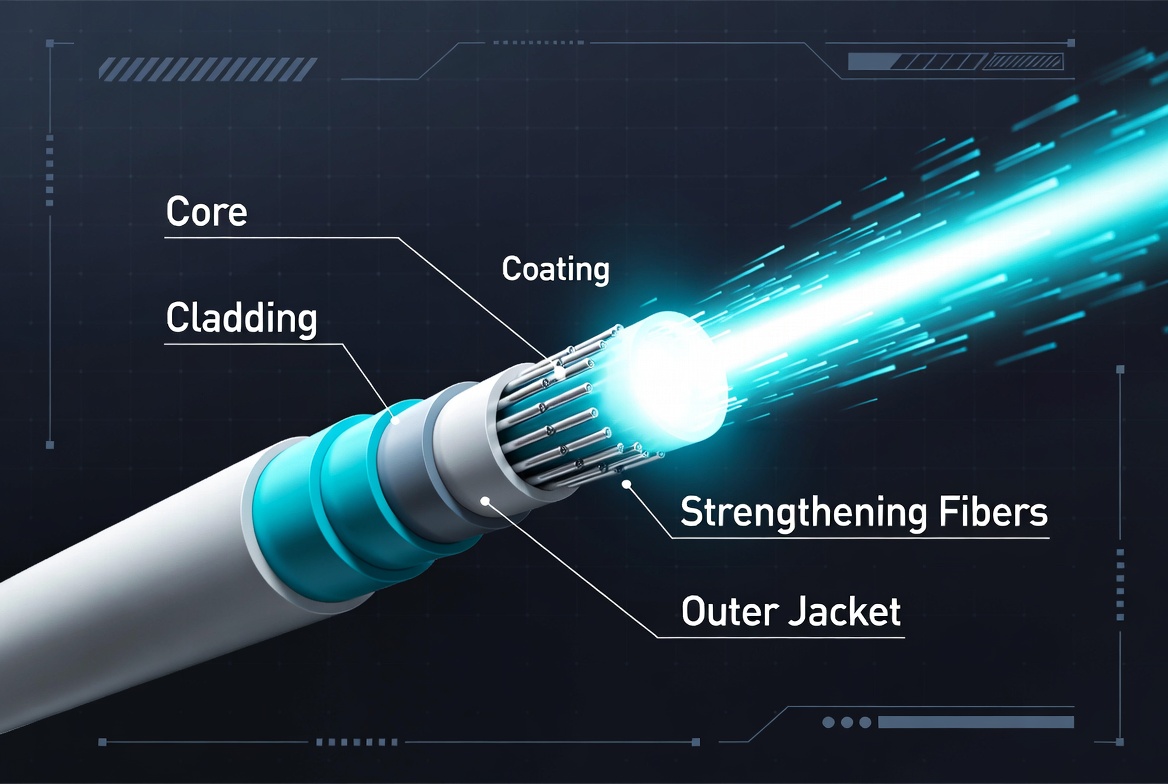
From an engineering standpoint, a fiber‑optic cable is a precisely controlled optical pathway, designed to guide light with minimal loss while surviving real‑world mechanical and environmental stress. [blog.biamp]
In most modern deployments, a typical fiber‑optic cable consists of five core elements:
- Core
- Cladding
- Coating (primary buffer)
- Strengthening fibers or strength members
- Outer jacket or cable coating [rsonline]
Each of these components can be customized for specific OEM and ODM requirements—for example, ultra‑low‑loss long‑haul links, high‑density data centers, or rugged industrial environments with vibration, oil, or extreme temperatures. [amerifiber]
The core is the heart of a fiber‑optic cable—a thin strand of high‑purity glass or plastic that carries the light signal. [truecable]
Typical characteristics:
- Diameter: Often measured in microns, and in many designs smaller than a human hair
- Material: Ultra‑pure silica (silicon dioxide) or, in some specialized cases, plastic
- Doping: "Dopants" are added to the glass to adjust its refractive index and control how light travels through the core. [blog.biamp]
Why this matters in real projects:
- Single‑mode fiber uses a small core to allow only one light mode to propagate, supporting extremely long distances with very low attenuation. [llis.nasa]
- Multimode fiber has a larger core that supports multiple light modes and higher data throughput over shorter distances, making it popular inside data centers and enterprise buildings. [rsonline]
In OEM and ODM scenarios, we often see customers under‑spec the core for cost reasons. As a manufacturing partner, our role is to validate those choices against target distance, wavelength, and transceiver type so that real‑world performance matches lab expectations. [nai-group]
Surrounding the core is the cladding, a concentric layer of glass with a slightly lower refractive index than the core. [truecable]
This difference in refractive index is what enables total internal reflection, effectively "bouncing" light back into the core instead of allowing it to leak out. [llis.nasa]
Key functions:
- Maintains signal integrity by preventing escape of light
- Defines numerical aperture and modal characteristics
- Helps control bending performance and loss behavior [amerifiber]
For high‑speed transmission cables used in dense routing or in compact equipment, we increasingly design with bend‑insensitive fibers, where modified cladding structures reduce loss even when fibers are tightly routed. This is particularly important in OEM assemblies for compact 5G radios, edge computing devices, and high‑density patch panels. [nai-group]
Immediately outside the cladding sits the coating, sometimes called the primary buffer. [blog.biamp]
This coating is usually made of a soft polymer and has three main roles:
- Absorb micro‑bends and small mechanical stresses
- Protect the glass from moisture and chemical attack
- Provide a basic layer of impact resistance during handling and installation [truecable]
From a manufacturing standpoint, coating quality and uniformity directly influence:
- Fiber lifetime and long‑term reliability
- Sensitivity to vibration in industrial environments
- Compatibility with different cable constructions (loose tube, tight buffer, ribbon, etc.) [rsonline]
In our OEM/ODM projects, we often recommend different coating formulations for indoor data center cables versus outdoor, direct‑burial, or submarine‑surrounding interconnects, where temperature cycling and moisture are much more aggressive. [amerifiber]
Glass alone cannot survive real‑world deployment. That is why fiber‑optic cables include strengthening fibers or strength members surrounding the coated fibers. [blog.biamp]
Common materials and forms:
- Aramid yarns (such as Kevlar) to handle tensile load and pull during installation
- Gel‑filled tubes for water blocking and additional cushioning
- Metallic or dielectric central strength members for structural stability
- Dark glass layers between bundles to prevent crosstalk when light leaks from one strand to another [truecable]
Practical benefits:
- Higher pull strength during cable installation, especially in long conduits
- Protection against crushing, bending, and vibration
- Enhanced reliability in industrial settings, transportation infrastructure, and undersea cables [llis.nasa]
In OEM and ODM design reviews, we emphasize matching strength member design to installation conditions. For example, an indoor patch cable in a controlled rack environment does not need the same tensile rating as a long outdoor aerial cable crossing a factory campus. Over‑engineering here increases cost without adding real value. [nai-group]
The outer jacket, sometimes simply called the coating or sheathing, is the visible exterior of the cable—but its design is far from cosmetic. [blog.biamp]
Primary roles:
- Protect against moisture, UV exposure, and temperature changes
- Resist abrasion, cutting, and impact during installation and daily operation
- Provide flame‑retardant performance (e.g., plenum or riser ratings in building code contexts) [rsonline]
In specialized environments, the jacket may also be designed to withstand:
- Chemicals and oils in industrial plants
- Rodents or even marine life—for example, sharks have been documented biting undersea cables, so some jackets integrate additional mechanical protection. [llis.nasa]
Color coding of jackets is another quiet but important part of UX for installers and network engineers: different colors can indicate fiber type, application, or generation, decreasing errors during patching and maintenance. [rsonline]
For network planners and equipment manufacturers, choosing between single‑mode and multimode fiber is a foundational architectural decision. [truecable]
High‑level differences:
- Single‑mode fiber (SMF)
- Small core diameter
- Best for long distances with very low loss
- Common in telecom backbones, long campus links, and hyperscale data centers [llis.nasa]
- Multimode fiber (MMF)
- Larger core, multiple light modes
- Higher bandwidth over short distances
- Common inside data centers, enterprise wiring closets, and equipment rooms [rsonline]
In OEM and ODM engagements, we often work with customers to standardize on one family of fiber designs across their product lines. This simplifies inventory and spare parts management while still meeting the performance requirements of each application tier. [nai-group]
Beyond the basic components, several technology trends are reshaping how manufacturers design high‑speed transmission cables. [amerifiber]
Notable developments:
- Ultra‑low‑loss fiber
Enables longer links without repeaters, supporting cost‑efficient long‑haul connections and data center interconnects. [amerifiber]
- Bend‑insensitive fiber
Reduces attenuation at tight bend radii, making routing easier in dense racks, FTTH, and 5G small‑cell deployments. [amerifiber]
- Smaller, more durable cable assemblies
Mechanical designs and materials are evolving toward higher density and robustness, allowing more fibers per rack unit and more channels per connector. [nai-group]
- Integration with photonic components
Advances such as photonic integrated circuits allow more integrated optics at the transceiver level, increasing pressure on cable assemblies to maintain low loss and high stability over temperature. [youtube]
As an OEM/ODM partner, we see a clear shift in customer requirements toward higher fiber counts in smaller diameters, higher mechanical reliability, and better compatibility with automated assembly and testing. [nai-group]
When international brands and system integrators work with a cable manufacturer, they generally do so under OEM or ODM models, each with different responsibilities and risks. [owiregroup]
In an OEM collaboration:
- The client owns the product design, including materials, geometry, and performance targets.
- The manufacturer builds according to these detailed specifications, often adding engineering recommendations for manufacturability and reliability. [wevolver]
OEM works best for:
- Mature product lines that the client wants to scale
- Projects where brand owners must fully control design and certification
- Highly specialized cables tightly tied to proprietary systems [owiregroup]
In an ODM model:
- The manufacturer designs and produces the product, often based on high‑level requirements from the client.
- The client purchases and markets the product under its own brand. [wevolver]
ODM is ideal when:
- A brand wants rapid entry into a new market without building internal cable design expertise
- There is a need for customized performance or form factor, but not for in‑house R&D
- Clients want to leverage the manufacturer's experience across multiple industries and regions [owiregroup]
At Zhuhai Yuxun Innovation Technology Co., Ltd., we provide both OEM and ODM services, helping overseas brands, wholesalers, and manufacturers balance speed‑to‑market, cost control, and long‑term reliability in their high‑speed transmission cable portfolios. [owiregroup]

When our engineering team works with international clients on new fiber‑optic cable projects, we usually guide them through a structured checklist. [owiregroup]
Key steps:
1. Define application and distance
- Data center, industrial plant, building backbone, or long‑haul telecom
- Required link length and margin over time [llis.nasa]
2. Choose fiber type and construction
- Single‑mode vs multimode
- Tight‑buffer vs loose‑tube, ribbon vs discrete fibers [rsonline]
3. Specify environment and compliance
- Indoor, outdoor, aerial, direct burial, or subsea
- Flame ratings, chemical exposure, temperature range [amerifiber]
4. Define mechanical requirements
- Pull strength, crush resistance, minimum bend radius
- Connector type and termination method [llis.nasa]
5. Align OEM/ODM responsibilities
- Who owns the design, tooling, and test plans
- How to manage quality assurance, documentation, and serialization [wevolver]
This process ensures that decisions about core, cladding, coatings, strength members, and jackets are made as an integrated system, not in isolation. [blog.biamp]
The following example table illustrates how a network planner might compare two typical fiber‑optic cable designs for different use cases. [truecable]
| Parameter | Single‑Mode Backbone Cable (llis.nasa) | Multimode Data Center Cable (rsonline) |
|---|---|---|
| Fiber type | Single‑mode OS2 | Multimode OM4 |
| Typical application | Campus and metro backbone | Short‑reach, high‑bandwidth links |
| Core diameter | Small, single mode (truecable) | Larger, multiple modes (truecable) |
| Maximum distance (typical) | Very long, low loss (llis.nasa) | Short to medium (rsonline) |
| Strength members | Higher tensile rating (truecable) | Optimized for flexibility (truecable) |
| Outer jacket | Outdoor‑rated, UV resistant (rsonline) | Indoor‑rated, flame retardant (rsonline) |
| Typical use case | Telecom, long campus links | Data centers, server rooms |
This type of structured comparison makes it easier for both technical and commercial teams to align quickly on the right product family before detailed OEM/ODM engineering begins. [nai-group]
From a user's point of view, fiber‑optic cables are a "plug‑and‑forget" component. From a manufacturer's perspective, each cable is a carefully engineered system where optical, mechanical, and environmental parameters must work together. [blog.biamp]
Working with a specialized high‑speed cable manufacturer offers several advantages:
- Access to current best practices in core, cladding, coating, and strength member design
- Ability to localize products for different regulatory environments and installation cultures
- Faster iteration cycles from concept to mass production, especially under an ODM model [wevolver]
For overseas brands, wholesalers, and system manufacturers who need reliable, custom fiber‑optic and other high‑speed transmission cables, an experienced OEM/ODM partner can significantly reduce risk while improving total system performance. [owiregroup]
If you are planning a new high‑speed transmission cable project—whether for data centers, industrial automation, telecom, or custom equipment—now is the right time to review your fiber‑optic cable design from the core outward. Define your performance targets, distances, and environments, then leverage an OEM/ODM partner with deep manufacturing experience to turn those requirements into robust, scalable cable solutions that support your business for years to come. [wevolver]
1. What are the basic components of a fiber‑optic cable?
A standard fiber‑optic cable usually includes a core, cladding, primary coating, strength members, and an outer jacket that protects the internal glass from the environment. [truecable]
2. Why is the cladding necessary if the core already carries the light?
The cladding has a slightly lower refractive index than the core, which forces light to reflect back into the core and prevents signal loss through leakage. [truecable]
3. How do I choose between single‑mode and multimode fiber?
Single‑mode fiber is best for long distances and very low loss, while multimode is optimized for short, high‑bandwidth links inside facilities like data centers or office buildings. [rsonline]
4. What is the role of strengthening fibers in a cable?
Strength members such as aramid yarn or central rods absorb pulling forces and mechanical stress so that the glass fibers remain within safe limits during installation and operation. [blog.biamp]
5. How does an OEM/ODM cable partnership work for fiber‑optic products?
In an OEM model, the client provides full designs and the manufacturer produces to spec; in an ODM model, the manufacturer designs and produces cables according to the client's high‑level requirements and brand positioning. [wevolver]
1. “Basic Components of a Fiber Optic Cable” – trueCABLE. https://www.truecable.com/blogs/cable-academy/basic-components-of-a-fiber-optic-cable
2. “Basic Components of a Fiber-Optic Cable” – Cables.com Blog. https://www.cables.com/cablesblog/basic-components-of-a-fiber-optic-cable.html
3. “Anatomy of a Cable – Optical Fiber” – Biamp. https://blog.biamp.com/anatomy-of-a-cable-optical-fiber/
4. “What are Fibre Optic Cables?” – RS Components Guide. https://www.rsonline.cn/web/content/discovery/ideas-and-advice/fibre-optic-cables-guide
5. “Fiber Optic Systems” – NASA Lessons Learned. https://llis.nasa.gov/lesson/881
6. “3 Fiber Optic Technology Trends Every Manufacturer Should Know” – NAI Group. https://www.nai-group.com/fiber-optic-technology-trends/
7. “Latest Fiber Optic Technology 2025 for Faster Networks” – Amerifiber. https://amerifiber.com/fiber-optic-trends/
8. “OEM vs ODM Manufacturing: A Comprehensive Technical Guide for Engineers” – Wevolver. https://www.wevolver.com/article/oem-vs-odm-manufacturing-a-comprehensive-technical-guide-for-engineers
9. “Cat6a/7/8 Network & Fiber Cable OEM/ODM Factory” – Owire. https://www.owiregroup.com/oem-odm/
10. “Top 5 Innovations in Optical Communications for 2024” – YouTube. https://www.youtube.com/watch?v=zgIOzM7bneQ


