:+86-13726207043
:info@yuxun.com
- All
- Product Name
- Product Keyword
- Product Model
- Product Summary
- Product Description
- Multi Field Search

Views: 222 Author: YUXUN CABLE Publish Time: 2026-06-14 Origin: Site


Content Menu
● What Is an Ethernet LAN Cable?
● A Brief History of Ethernet and LAN Cables
● How Ethernet Cable Categories Evolved
>> Early Categories: Cat1 to Cat4
>> High-Speed Era: Cat5, Cat5e, and Cat6
>> Next-Generation Categories: Cat6A, Cat7, Cat7A, and Cat8
● Ethernet Cables in Today's Networks
● Expert Insight: Why Ethernet Still Matters in a Wireless World
● LAN Cable Market Trends and Opportunities
● OEM and ODM LAN Cable Manufacturing: What Buyers Should Know
● How Zhuhai Yuxun Supports Global OEM & ODM Customers
● Practical Guide: How to Choose the Right Ethernet Cable
● Installation Best Practices for Reliable LAN Performance
● Looking Ahead: Future Directions in LAN Cable Technology
● Call to Action: Partnering with a Specialized LAN Cable Manufacturer
● Frequently Asked Questions (FAQ)
High-speed Ethernet LAN cables remain the unsung heroes behind reliable networks in homes, offices, factories, and data centers worldwide, and understanding their history helps buyers and engineers choose the right solutions for today's demanding applications. Drawing on my experience working with global OEM and ODM cable manufacturers, I'll walk you through how Ethernet cables evolved, what the latest categories mean in practice, and how a specialized manufacturer like Zhuhai Yuxun Innovation Technology Co., Ltd. can support brand owners, wholesalers, and equipment makers with customized LAN cable solutions. [telecom.samm]
At its core, an Ethernet LAN cable (often simply called a LAN cable or network cable) is a twisted-pair copper cable that connects devices such as computers, switches, routers, servers, gaming consoles, and industrial controllers within a local area network (LAN). It provides a physical, wired path for data signals, delivering stable, high-speed, and low-latency connections that are often more secure and reliable than Wi‑Fi in critical environments. [wifihire.co]
Ethernet cables typically use RJ45 connectors and are built from pairs of copper conductors twisted together to reduce electromagnetic interference. Different categories (Cat5e, Cat6, Cat6A, Cat7, Cat8, etc.) define each cable's performance in terms of speed, bandwidth, and maximum transmission distance. [us.misumi-ec]
Ethernet was invented in 1973 at Xerox's Palo Alto Research Center (PARC) by Robert Metcalfe and colleagues, and it quickly became the dominant technology for local area networking. The IEEE released the first official Ethernet standard in 1983, specifying how data would be transmitted over the network and the maximum distances cables could support. [standards.ieee]
In parallel, telecom and cabling standards bodies such as the Telecommunications Industry Association (TIA) and the Electronics Industries Alliance (EIA) released the first joint structured cabling standard, EIA/TIA‑568, in 1991, laying the foundation for today's structured cabling systems in buildings. Over the decades, Ethernet has scaled from early megabit speeds to today's 40 Gbps and beyond, while remaining backward-compatible and widely adopted across residential, commercial, and industrial networks. [telecom.samm]
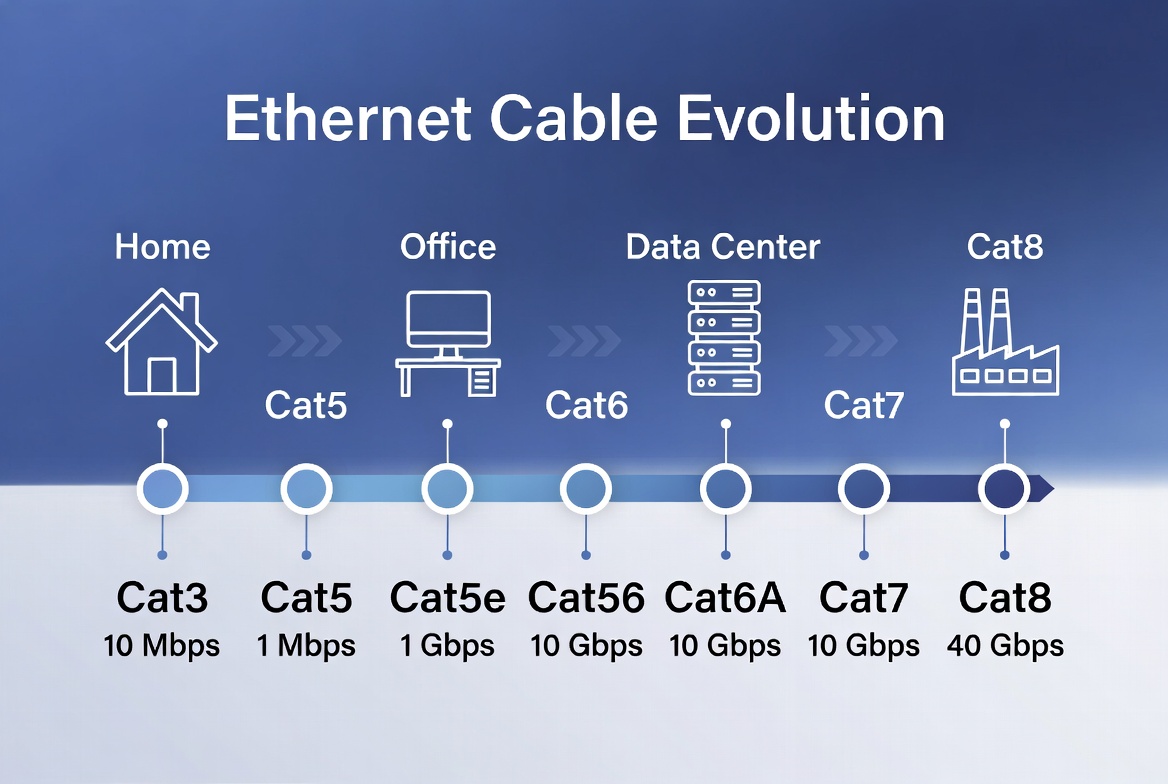
Modern twisted‑pair Ethernet cables are grouped into "categories" defined by performance characteristics such as data rate (Mbps/Gbps) and bandwidth (MHz). Below is a simplified view of how the categories evolved and what they mean in practice. [telecom.samm]
- Cat1: Unshielded twisted pair introduced around 1985, supporting about 1 Mbps, mainly for voice and low‑speed data. [telecom.samm]
- Cat2: Improved to 4 Mbps, used for early LAN applications. [telecom.samm]
- Cat3: Used four twisted pairs and supported 10 Mbps at 16 MHz, carrying voice, data, and video on a single cable. [telecom.samm]
- Cat4: Designed largely for Token Ring networks, capable of 16 Mbps, which was considered high performance at the time. [telecom.samm]
These early categories are now largely obsolete but laid the groundwork for structured cabling concepts and performance metrics still used today. [telecom.samm]
When Cat5 arrived in 1995, it accelerated LAN performance with dual-rated 10/100 Mbps support and 100 MHz bandwidth, allowing video, phone, and data transmission up to 100 m without amplification. It became the backbone of many office networks and remains in legacy installations. [telecom.samm]
Cat5e (enhanced Cat5) improved noise performance and supported 1 Gbps at 100 MHz, although full-performance distance is often cited as shorter than the theoretical 100 m depending on installation quality. This made Cat5e a cost-effective choice for gigabit networks in homes and small offices. [us.misumi-ec]
Cat6 further improved crosstalk and performance, supporting 1 Gbps up to 100 m with 250 MHz bandwidth and, in some implementations, up to 10 Gbps over shorter distances. Shielded versions reduce interference and are widely used in environments with more electrical noise. [us.misumi-ec]
With Cat6A, introduced around 2008, Ethernet cables achieved speeds up to 10 Gbps with 500 MHz bandwidth, and structured cabling could reliably deliver 10G Ethernet over copper up to 100 m. These cables are available in shielded constructions that help maintain performance in dense or noisy environments. [us.misumi-ec]
Cat7 (around 2010) increased bandwidth to 600 MHz and used additional shielding, while Cat7A pushed bandwidth further to around 1.2 GHz, supporting specialized high-speed applications. Although Cat7/Cat7A are less standardized than Cat6A in some regions, they are popular in certain data center and broadcast installations. [us.misumi-ec]
Cat8 is the latest major twisted‑pair Ethernet category, designed primarily for data centers and high-performance computing. It offers up to 40 Gbps with bandwidth around 2000 MHz, typically over distances up to 30 m at full speed, serving switch‑to‑server or switch‑to‑switch links in high‑density racks. [wifihire.co]
While legacy categories still exist, Cat5e, Cat6, and Cat6A are the most commonly deployed Ethernet cables in modern networks. Cat5e remains attractive for cost-sensitive projects, while Cat6 and Cat6A are preferred for Gigabit and 10G networks, especially in new installations where longevity and future-proofing are priorities. [us.misumi-ec]
In data centers and large enterprises, higher categories such as Cat7, Cat7A, and Cat8 are used for short‑reach, high‑bandwidth links, while fiber optic cables handle longer distances and backbone connections. At the same time, Ethernet remains a trusted choice for industrial automation, smart factories, and IoT deployments, where stable, predictable performance is critical. [snsinsider]
From an industry practitioner's perspective, Ethernet LAN cables continue to matter for several reasons:
- Predictable performance: Wired links deliver consistent throughput and latency, essential for video conferencing, real‑time control, and mission‑critical services. [wired]
- Security and reliability: Physical connections reduce the risk of wireless interception and interference, making them ideal for regulated industries and tightly controlled facilities. [wired]
- Scalability: As standards evolve, Ethernet has consistently scaled to higher speeds while leveraging existing infrastructure and installation practices. [standards.ieee]
Even as Wi‑Fi standards improve, many organizations adopt a hybrid strategy, using Ethernet for core and high‑priority connections while relying on wireless for mobility and convenience. This hybrid approach underlines the ongoing importance of high‑quality LAN cables and structured cabling systems. [wifihire.co]
The global LAN cable market is experiencing robust growth, driven by increasing demand for high‑speed and reliable network connectivity across residential, commercial, and industrial sectors. One recent analysis estimates that the LAN cable market was valued at approximately USD 14.08 billion in 2023 and could reach USD 44.41 billion by 2032, representing a compound annual growth rate (CAGR) of about 13.63%. [snsinsider]
In parallel, the broader wire and cable industry is expected to grow significantly, with some forecasts projecting a value of around USD 232 billion by 2025 at an annual growth rate of about 5%, highlighting sustained investment in communication and power infrastructure. These trends reflect continued expansion in data centers, cloud services, industrial automation, and smart buildings, all of which rely on reliable LAN cabling. [conwire]
For overseas brand owners, wholesalers, and equipment manufacturers, partnering with the right OEM/ODM LAN cable producer is critical to meeting technical requirements and market expectations. OEM (Original Equipment Manufacturer) and ODM (Original Design Manufacturer) models support different customer needs: [wevolver]
- OEM: The manufacturer produces LAN cables according to the customer's specifications and branding, often based on established designs and standards. [wevolver]
- ODM: The manufacturer helps design and develop new or customized LAN cable solutions, including materials, constructions, and packaging, which can then be branded by the customer. [wevolver]
Industry trends such as Industry 4.0, IoT, and smart factories have increased demand for high‑quality LAN cables with enhanced shielding, durability, and compliance with global standards. At the same time, buyers are paying closer attention to sustainability, supply chain resilience, and the ability to support shorter lead times and customized SKUs for different markets. [conwire]
As a manufacturer specializing in LAN cables and related electrical cables, Zhuhai Yuxun Innovation Technology Co., Ltd. focuses on serving overseas brand owners, wholesalers, and manufacturers with tailored OEM and ODM services. Building on the evolution of Ethernet standards and market demands, we help customers bridge the gap between engineering requirements and end‑user expectations.
From an expert UX and product perspective, a strong LAN cable partner should:
- Understand international standards and regional requirements to ensure compliance and interoperability.
- Offer flexible customization of conductor size, insulation materials, shielding types (UTP, FTP, SFTP), jacket materials (PVC, LSZH, PE), and colors.
- Provide reliable manufacturing processes, testing, and quality assurance to maintain consistent performance across production batches. [ibisworld]
By combining technical expertise with OEM/ODM flexibility, manufacturers like Zhuhai Yuxun enable customers to bring differentiated LAN cable products to market while maintaining cost efficiency and performance consistency.

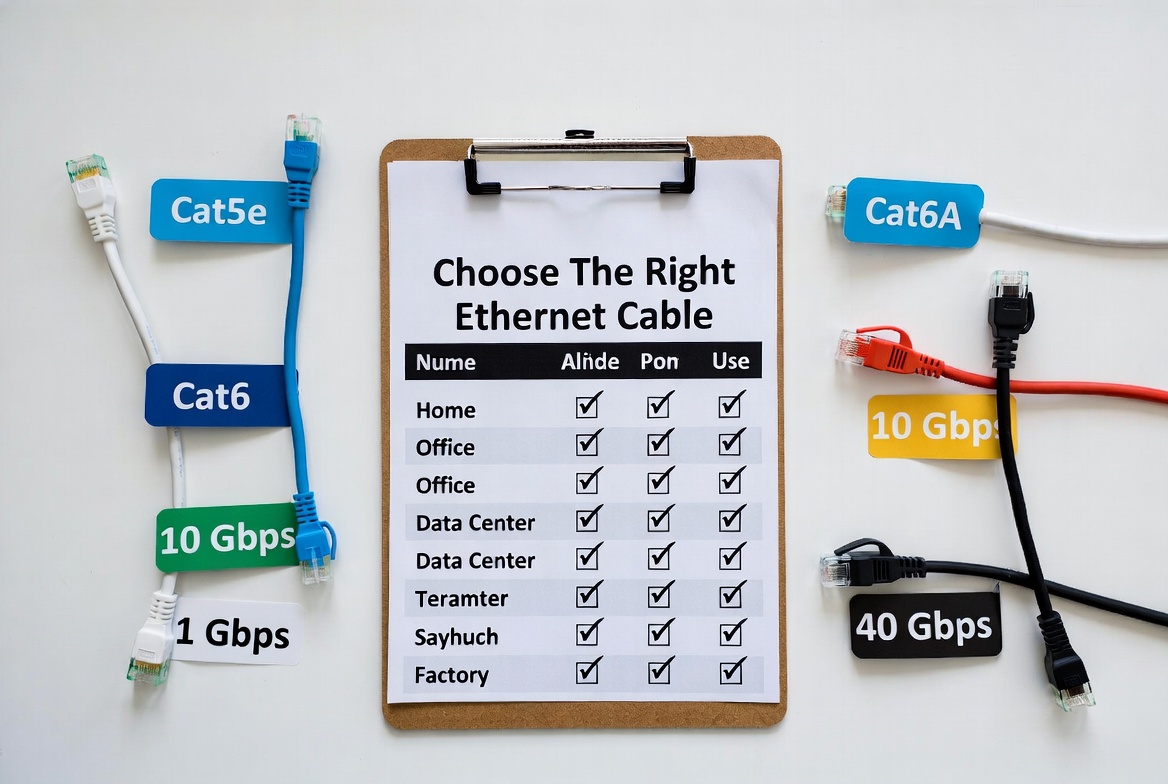
Choosing the right Ethernet LAN cable depends on your application, performance needs, and budget. Below is a practical framework you can apply when specifying or purchasing cables.
1. Speed and bandwidth requirements
- For basic internet and office tasks, Cat5e is often sufficient (up to 1 Gbps). [us.misumi-ec]
- For Gigabit with better margin and for small business networks, Cat6 is a strong choice. [us.misumi-ec]
- For 10G Ethernet and future-proofing in new installations, Cat6A or above is recommended. [us.misumi-ec]
2. Environment and installation conditions
- Indoor plenum, riser, or general purpose spaces may require different jacket ratings according to building codes.
- Outdoor or direct‑burial installations need UV‑resistant, waterproof jackets and robust construction to withstand temperature and moisture. [telecom.samm]
3. Electromagnetic environment
- In high‑interference environments (near heavy machinery, power lines, or radio equipment), shielded cables (such as F/UTP or S/FTP) help maintain signal integrity. [us.misumi-ec]
- In typical home and office networks, unshielded twisted pair (UTP) often suffices when properly installed. [us.misumi-ec]
4. Distance and topology
- For channel lengths up to 100 m, Cat5e, Cat6, and Cat6A are widely used according to their performance class. [telecom.samm]
- For very short, high‑speed connections within racks, Cat8 offers up to 40 Gbps over approximately 30 m. [telecom.samm]
| Typical Use Case | Recommended Category |
|---|---|
| Home internet up to 1 Gbps | Cat5e or Cat6 |
| Small office Gigabit network | Cat6 |
| 10G switch‑to‑switch in office | Cat6A |
| Short high‑speed data center links | Cat7 / Cat7A / Cat8 |
| Industrial automation & IoT networks | Cat6 / Cat6A with appropriate shielding |
This structured approach helps both technical and non‑technical buyers make informed decisions and communicate requirements clearly to OEM and ODM partners.
Even the best Ethernet cable cannot deliver full performance if it is poorly installed. From an expert's perspective, the following practices are essential:
- Avoid sharp bends and kinks: Ethernet cables contain precise twisted pairs that can be damaged or detuned by tight bends; use gentle curves when routing around corners. [wifihire.co]
- Protect against physical damage: Avoid placing cables in high‑traffic areas or under heavy objects; use conduits or cable trays where appropriate. [wifihire.co]
- Maintain separation from power cables: Where possible, keep data cables separated from high‑voltage lines to reduce interference.
- Test and verify: Use appropriate cable testers to verify continuity, performance, and compliance with the required category standard after installation. [rsonline]
For OEM and ODM buyers, it is also important to provide clear installation guides and labeling to end-users, which enhances UX, reduces support calls, and reinforces brand credibility.
As Ethernet approaches its 50‑year milestone, ongoing innovation continues in both standards and materials. Future developments may include higher category copper standards, more efficient shielding designs, and expanded integration with power delivery technologies such as Power over Ethernet (PoE). [conwire]
At the same time, Industry 4.0 and smart manufacturing are pushing for ruggedized LAN cables that can withstand vibration, chemicals, and temperature extremes while maintaining high‑speed data transmission. OEM and ODM manufacturers that invest in advanced materials, quality control, and flexible production will be well positioned to serve these emerging demands. [snsinsider]
If you are an overseas brand owner, wholesaler, or equipment manufacturer seeking reliable OEM/ODM LAN cable solutions, partnering with a specialized producer can give you a competitive edge in performance, cost, and branding. By aligning your product roadmap with an experienced manufacturer, you can:
- Build portfolios that cover Cat5e to Cat8 and beyond, tailored to your target markets.
- Offer differentiated features such as custom lengths, colors, packaging, and labeling.
- Ensure consistent quality and compliance with relevant international standards.
For organizations looking to strengthen their network product line, now is the ideal time to review your existing Ethernet cable offerings and explore how a dedicated LAN cable manufacturer can help you upgrade, expand, or customize your portfolio in line with global market trends. [snsinsider]
1. What is the difference between Cat5e and Cat6 Ethernet cables?
Cat5e supports up to 1 Gbps at 100 MHz, making it suitable for many home and small office networks, while Cat6 improves noise performance and can support 1 Gbps up to 100 m (and even 10 Gbps over shorter distances) at 250 MHz. [us.misumi-ec]
2. Is Cat6A always better than Cat6?
Cat6A offers higher bandwidth (around 500 MHz) and supports 10 Gbps up to 100 m, which provides better future-proofing, but it is typically thicker, less flexible, and more expensive than Cat6. The "better" choice depends on your performance needs and installation constraints. [telecom.samm]
3. When should I consider Cat8 cables?
Cat8 is designed mainly for short‑distance, high‑bandwidth links such as data center switch‑to‑server connections, delivering up to 40 Gbps over about 30 m. For general office or home networks, Cat6 or Cat6A is usually more cost‑effective. [wifihire.co]
4. Are shielded Ethernet cables necessary for home networks?
In most home and small office environments, unshielded twisted pair (UTP) cables perform well when properly installed, as long as they are not routed alongside strong sources of electromagnetic interference. Shielded cables become more important in industrial, data center, or high‑noise environments. [wifihire.co]
5. How do OEM and ODM LAN cable services benefit brand owners?
OEM and ODM services allow brand owners to outsource manufacturing and, if needed, design, while maintaining their own branding and market positioning. This approach enables faster time‑to‑market, broader product portfolios, and access to specialized manufacturing expertise without building in‑house production capabilities. [wevolver]
1. Cables.com – “A History of Ethernet Cables.” https://www.cables.com/cablesblog/a-history-of-ethernet-cables.html
2. SAMM Telecom – “Categories of Ethernet LAN Cables in History.” https://telecom.samm.com/history-of-ethernet-lan-cables-categories
3. IEEE – “Celebrating the Technology's 50th Year of Innovation.” https://standards.ieee.org/beyond-standards/ethernet-50th-anniversary/
4. Wired – “Everything You Need to Know About Ethernet.” https://www.wired.com/story/what-is-ethernet/
5. SNS Insider – “LAN Cable Market Size, Share & Growth Report 2032.” https://www.snsinsider.com/reports/lan-cable-market-2441
6. Conwire – “Cable & Wire Industry Trends.” https://www.conwire.com/blog/whats-new-in-the-industry-current-trends-for-wire-and-cable/
7. MISUMI – “6 Types of Ethernet Cables: Basic Properties and Common Uses.” https://us.misumi-ec.com/blog/6-types-ethernet-cables/
8. WiFiHire – “What is an Ethernet Cable? Types, Uses and Benefits.” https://www.wifihire.co.uk/ethernet-cables-types-uses-benefits/8978/
9. RS Components – “Essential Guide to Choosing and Using Ethernet Cables.” https://www.rsonline.cn/web/content/discovery/ideas-and-advice/essential-guide-to-choosing-and-using-ethernet-cables
10. Wevolver – “OEM vs ODM Manufacturing: A Comprehensive Technical Guide for Engineers.” https://www.wevolver.com/article/oem-vs-odm-manufacturing-a-comprehensive-technical-guide-for-engineers


