:+86-13726207043
:info@yuxun.com
- All
- Product Name
- Product Keyword
- Product Model
- Product Summary
- Product Description
- Multi Field Search

Views: 291 Author: YUXUN CABLE Publish Time: 2026-06-26 Origin: Site


Content Menu
● What Is RS485 and Why Cable Choice Matters
● Key RS485 Cable Types at a Glance
● Twisted Pair RS485 Cable: The Industrial Workhorse
● Shielded RS485 Cable: When EMI Becomes a Real Risk
● RS485 USB Cables: Bridging Field Devices and PCs
● RJ45 RS485 Cables: RS485 in an Ethernet‑Style Form Factor
● RS485 with DB9 and Terminal Connectors: Ready‑to‑Use Assemblies
● How to Choose the Right RS485 Cable for Your Project
>> 1. Start with the environment
>> 2. Align with distance, speed, and impedance
>> 3. Consider mechanical and environmental constraints
● Example RS485 Cable Specifications from an Industrial Supplier
● Practical Selection Checklist for RS485 Projects
● Why Work with an OEM / ODM RS485 Cable Manufacturer
● Real‑World Best Practices to Avoid RS485 Troubles
● Call to Action: Design Your Next RS485 Project with OEM Support
● FAQ
As an engineer working with high‑speed industrial networks, I have seen RS485 links either run flawlessly for years—or fail randomly—purely because of cable choice. When you understand how twisted pair, shielded, USB, and RJ45 RS485 cables behave in real‑world environments, you can cut downtime, reduce noise issues, and design more reliable systems from day one.

RS485 is a robust differential signaling standard widely used in industrial automation, building management, and sensor networks for long‑distance, multi‑drop communication. In practice, the right RS485 cable can be the difference between clean data and intermittent, hard‑to‑diagnose communication errors.
- Typical communication distances: up to about 1200 m in well‑designed systems.
- Typical impedance: 120 Ω cables are recommended for high‑speed, long‑distance RS485 links.
- Typical protocols over RS485: Modbus RTU, Profibus, and many proprietary industrial protocols.
From a B2B buyer's standpoint, selecting the correct cable type (twisted pair, shielded, USB, RJ45, or DB‑style connectors) directly impacts installation cost, ease of maintenance, and long‑term reliability. [loudscale]
Before diving deeper, here is a quick overview of the main RS485 cable options and where they fit best.
| RS485 cable type | Typical use case | Key strength |
|---|---|---|
| Twisted pair RS485 cable | Standard industrial fieldbus and sensors | Long‑distance, cost‑effective |
| Shielded RS485 cable | High‑EMI factories and power‑dense environments | Strong noise immunity |
| RS485 USB cable | PC‑to‑device testing and diagnostics | Plug‑and‑play, portable |
| RJ45 RS485 cable | Building automation (e.g. BACnet MS/TP) | Easy installation, RJ45 form factor |
| RS485 with DB/terminal | Device‑to‑device and industrial PCs | Ready‑to‑use, custom connectors |
Twisted pair RS485 cables are the most common choice for general‑purpose RS485 networks in industrial and building automation projects.
Typical structure
- Conductor: Solid or stranded tinned copper, usually 1–2 pairs or more.
- Twisted pairs: The twist reduces EMI and crosstalk between lines.
- Impedance: Around 120 Ω for long‑distance, high‑speed links.
Where twisted pair RS485 excels
- Industrial automation lines and PLC interconnections
- Building management systems (BMS) and field devices
- Distributed sensor networks using Modbus RTU or Profibus
A widely used configuration is a 4‑pair 28 AWG stranded tinned copper cable with aluminum foil shield and braided copper, designed to maintain 120 Ω impedance and stable performance over distance.
Why engineers choose twisted pair
- Long reach: Practical distances up to 1200 m in correctly terminated networks.
- Balanced cost: Good balance of price, performance, and availability.
- Flexibility: Multiple pairs can support redundant channels or additional signals in one cable.
For most OEMs and panel builders, twisted pair RS485 is the default baseline; more specialized cable types are added when EMI or termination needs become more demanding. [gushwork]
In high‑EMI environments—such as factories with motors, VFDs, welding equipment, or RF sources—even a well‑twisted pair may not be enough. That is where shielded RS485 cable comes in.
Typical structure of shielded RS485 cables
- Unshielded twisted pairs, wrapped with Al/PET foil, braided copper, or both
- A drain wire for proper grounding
- Outer jacket materials such as PVC, LSZH, or PE depending on the installation environment
Shield options and what they mean
- Foil shielded: Lightweight, provides moderate noise protection and is easy to terminate.
- Foil + braid shielded: Delivers maximum EMI resistance, ideal for critical industrial or even military‑grade applications.
Key benefits in real projects
- Improved data integrity in noisy environments
- Reduced external EMI impact on sensitive data lines
- Better overall signal quality and fewer intermittent faults
For example, RS485 cables with aluminum + polyester + tinned copper braid up to 90% coverage and steel wire armor, combined with LSZH jackets, are engineered for indoor or outdoor use where UV resistance, oil resistance, and non‑halogen requirements must be met.
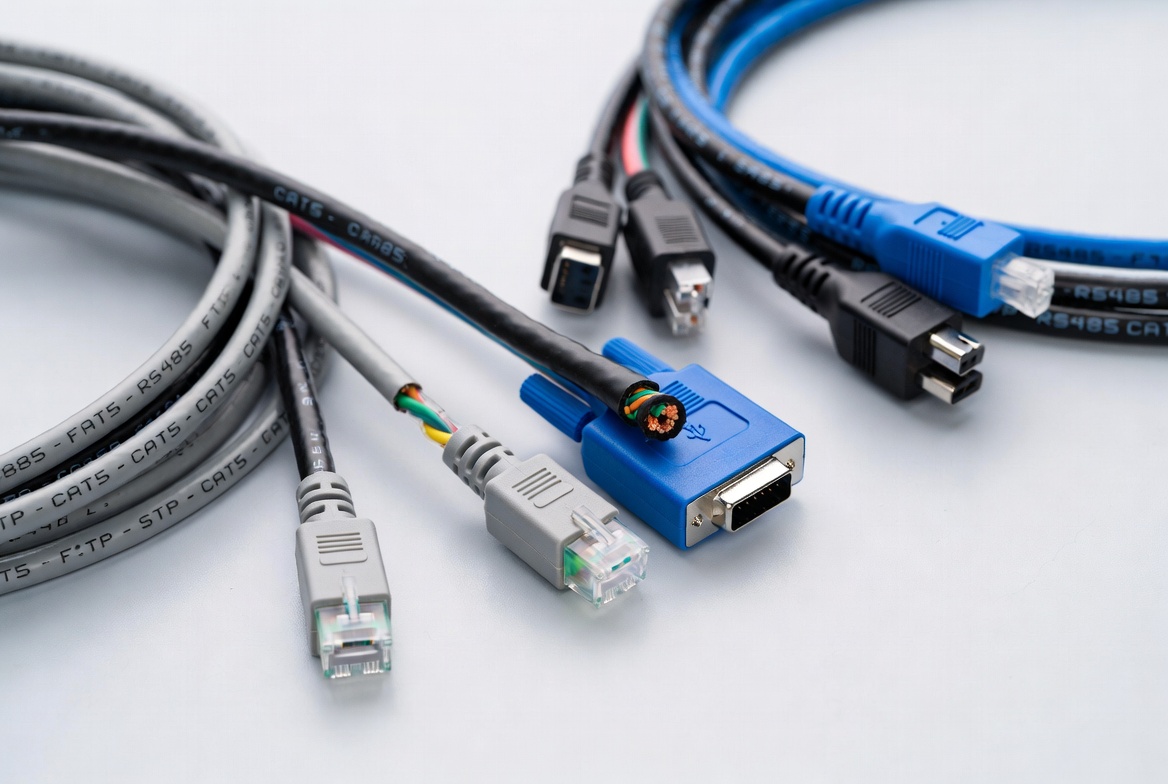
RS485 USB cables integrate an RS485‑to‑USB converter into a compact assembly so engineers can connect field devices directly to laptops or PCs.
Typical structure
- One end: USB Type‑A or Type‑C
- Other end: RS485 terminal block, DB9 connector, or bare wires
- Embedded RS485‑to‑USB converter chip in the cable
Practical applications
- Field service engineers performing onsite diagnostics
- Commissioning new RS485 devices or updating firmware
- Laboratory environments where test setups change frequently
Key features that matter in daily work
- Plug‑and‑play operation with major OS platforms (Windows/macOS/Linux)
- Driver support that keeps setup time low
- Compact form factor for portability in field toolkits
While these cables are not typically used for permanent installation, they are essential tools for debugging and short‑term connectivity in RS485 projects.
In many modern building automation and industrial systems, RS485 signals are routed through cables that resemble Ethernet patch cords. These RJ45 RS485 cables maintain RS485 as the physical layer but use familiar 8P8C connectors.
Structure and signaling
- Standard 8P8C RJ45 connector on one or both ends
- Differential A/B signal pairs mapped to specific pins
- Variants using shielded or unshielded twisted pairs
Typical applications
- BACnet MS/TP networks in building automation
- Serial‑over‑Ethernet (SoE) converters
- DIN‑rail RS485 devices designed with RJ45 sockets for quick daisy‑chain wiring
Practical advantages
- Fast installation: Uses well‑known RJ45 connectors and tooling.
- Compact wiring: Clean, modular panel layouts, especially in control cabinets.
A critical point: despite the RJ45 connector and sometimes Cat‑style cable, these links are not Ethernet—the physical layer is RS485, not TCP/IP. Treating them as Ethernet can lead to configuration mistakes and troubleshooting confusion.
Many legacy industrial PCs, PLCs, and converters still rely on RS485 through DB‑style connectors or terminal blocks. For these installations, pre‑terminated RS485 cable assemblies can significantly reduce onsite wiring time.
Common formats
- DB9, DB15, or DB25 connectors
- Screw terminal blocks for quick wiring
- Cable core similar to twisted pair or shielded RS485 constructions
Where they are typically used
- Industrial PCs with native serial ports
- Master control units talking to multiple RS485 PLCs
- Device‑to‑device connections where connectors are fixed by the equipment design
These assemblies are popular with system integrators who want consistent wiring quality and reduced risk of mis‑termination in the field.
From a buyer's and engineer's perspective, the application environment should be your first decision driver. [gushwork]
- Standard industrial workshops or building interiors
- Use twisted pair RS485 cable for cost‑effective, long‑range communication.
- High‑EMI environments (near motors, transformers, VFDs, RF equipment)
- Choose shielded RS485 (foil or foil + braid) to protect integrity.
- Control rooms and PC‑based maintenance
- Keep RS485 USB cables on hand for testing and configuration.
- Building automation with RJ45 ports
- Deploy RJ45 RS485 cables specified by the device manufacturer.
- Legacy and device‑specific setups
- Use RS485 cables with DB or terminal connectors to match equipment ports.
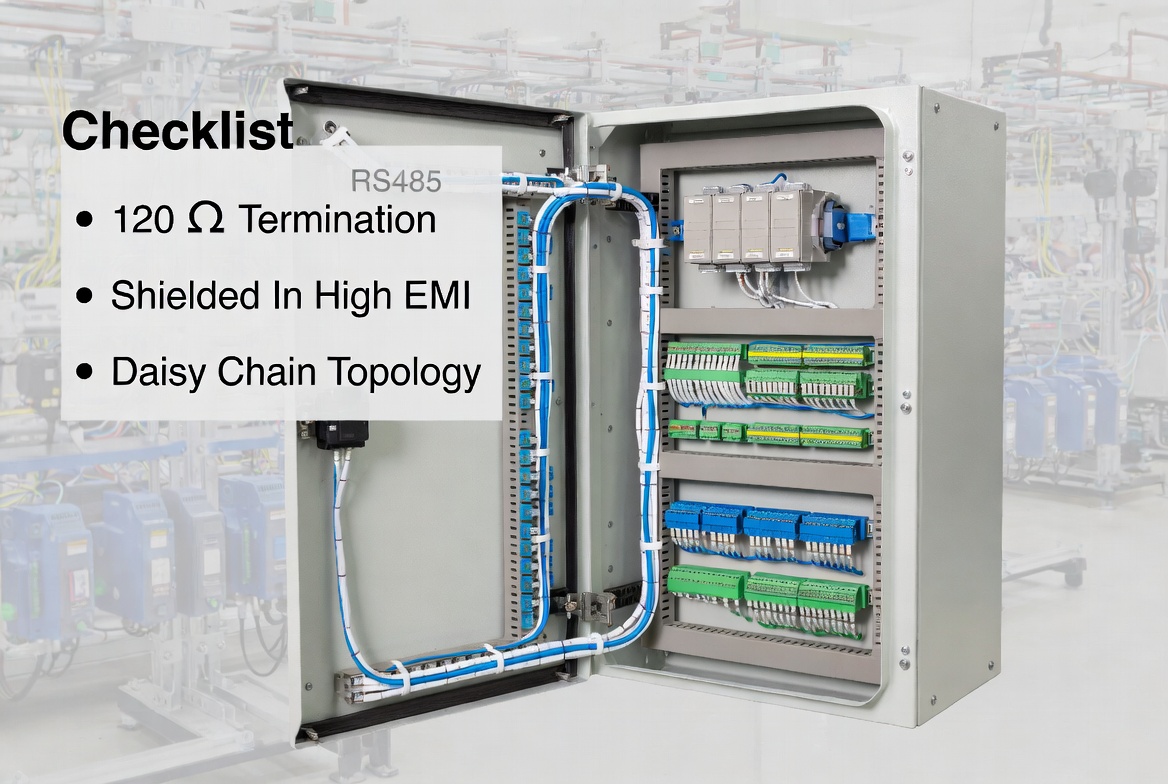
For longer links and higher baud rates, ensure the cable has 120 Ω impedance and adequate pair twisting to minimize reflections and noise. Combine this with proper line termination at both ends and, where necessary, bias resistors to prevent floating lines.
- Indoor vs outdoor, UV exposure, and oil or chemical contact
- Fire and safety requirements such as LSZH (Low Smoke Zero Halogen) jackets
- Flexibility and bending radius for moving or tray‑mounted cables
Industrial RS485 cable series using LSZH jackets, high‑coverage tinned copper braid, and steel wire armor are tailored for demanding environments where standard PVC‑jacketed cables may be insufficient.
Below is an example of how professional RS485 cable lines are structured to meet different installation requirements.
| SKU | Pairs & AWG | Shield structure | Jacket / environment |
|---|---|---|---|
| 73004 | 4 pairs, 28 AWG stranded TC | Aluminum + polyester foil | PVC, indoor use |
| 73005 | 5 pairs, 28 AWG stranded TC | Aluminum + polyester foil | PVC, indoor use |
| 73102 | 2 pairs, 28 AWG stranded TC | Aluminum + polyester + TC braid 65% | PVC, indoor (not riser/plenum) |
| 73103 | 3 pairs, 28 AWG stranded TC | Aluminum + polyester + TC braid 65% | PVC, indoor (not riser/plenum) |
| 732016 | 1 pair, 24 AWG stranded TC | Aluminum + polyester + TC braid 90% + steel armor | LSZH/SWB/LSZH, indoor & UV resistant |
| 732046 | 4 pairs, 24 AWG stranded TC | Aluminum + polyester + TC braid 90% + steel armor | LSZH/SWB/LSZH, sunlight & oil resistant |
For OEM and ODM projects, these base constructions can be customized with different jacket colors, pair counts, print legends, and connector assemblies to match branding and system requirements. [0756yuxun.en.ecplaza]
From a UX and project‑management standpoint, engineers and buyers benefit from a clear, repeatable checklist before issuing a cable order. [gushwork]
1. Define communication parameters
- Maximum distance and baud rate
- Number of nodes on the RS485 bus
2. Map the installation environment
- EMI level (near drives, heavy equipment, or low‑noise office/BMS)
- Indoor vs outdoor, tray, conduit, or moving cable applications
3. Confirm regulatory and safety needs
- LSZH, flame rating, and building code compliance where required
4. Align connectors and terminations
- Bare ends vs terminal blocks, DB9, RJ45, or hybrid options
5. Plan for scalability
- Extra pairs for future expansion or additional signals
- Length margin for routing changes during installation
Working through these steps with your cable manufacturer or OEM partner ensures the final RS485 cable solution is both technically sound and cost‑effective. [blog.saleslayer]
For global brand owners, wholesalers, and equipment manufacturers, partnering with an OEM/ODM cable factory offers several strategic advantages. [blog.saleslayer]
- Application‑driven design: Cables tailored to your equipment's electrical and mechanical requirements rather than generic stock items.
- Consistent quality across projects: Stable material formulations, shielding coverage, and impedance control reduce field failures.
- Brandability: Customized jackets, colors, and labeling support clear channel differentiation and brand recognition.
- Supply‑chain efficiency: Bulk production, container‑level planning, and predictable lead times help maintain inventory without overstocking. [blog.saleslayer]
A manufacturer focused on high‑speed transmission cables can extend the same engineering and process controls to RS485, Ethernet, and other communication cable families, simplifying sourcing for multi‑protocol product lines. [yuxun]
Based on repeated field experience and feedback from installers and system integrators, a few practices consistently prevent RS485 headaches. [loudscale]
- Match cable impedance and termination: Use 120 Ω cables and correctly sized termination resistors at the ends of the bus.
- Ground shields correctly: Connect the drain wire and shield to ground at designated points to avoid ground loops and to maximize EMI protection.
- Avoid star topologies: RS485 prefers daisy‑chain layouts; star wiring often leads to reflections and unstable communication.
- Separate from power cables: Maintain physical separation from high‑power lines, or use shielded and armored cables where this is not possible.
- Document your network: Label segments, connectors, and junctions so future maintenance is faster and less error‑prone.
These small decisions during design and installation dramatically increase the long‑term stability of RS485 networks—especially in demanding industrial environments. [loudscale]
If you are planning a new RS485‑based control system, upgrading legacy equipment, or building your own branded cable line, collaborating early with a specialized cable manufacturer gives you more than just a part number. You gain access to engineering support on conductor sizing, shielding strategies, jacket selection, and connectorization so your project performs reliably from prototype through full‑scale deployment. [robertsiegers]
Whether you need twisted pair, shielded, RJ45‑based, or USB‑integrated RS485 solutions, you can specify the exact structure, materials, labeling, and testing protocols to match your technical requirements and market positioning. [yuxun]
Q1: Do I always need shielded RS485 cable in industrial environments?
In many standard industrial applications, well‑designed twisted pair RS485 cable is sufficient, especially when routed away from high‑power lines. However, in areas with strong EMI (like near motors or welding equipment), using shielded RS485 cable significantly improves noise immunity and reduces communication errors.
Q2: Can I use Ethernet Cat5e or Cat6 cables for RS485?
You can physically use Cat5e/Cat6 as a twisted pair medium for RS485 if impedance and pair assignment are carefully managed. But you must remember that the link remains RS485 at the physical layer, and RJ45‑based RS485 networks are not interchangeable with standard Ethernet ports.
Q3: What is the maximum recommended length for an RS485 cable?
Under typical conditions, RS485 networks can reach distances of up to around 1200 m when using appropriate 120 Ω cable and correct terminations. Higher baud rates, poor shielding, or high‑EMI environments may require shorter runs or repeaters to maintain signal integrity.
Q4: When should I choose LSZH jackets for RS485 cables?
LSZH jackets are recommended in enclosed public spaces, tunnels, or facilities where low smoke and zero halogen emissions are required for safety and regulatory compliance. They are also useful in applications that demand better fire performance and reduced toxic fumes compared to standard PVC jackets.
Q5: Are RS485 USB cables suitable for permanent installations?
RS485 USB cables are mainly designed for temporary connections, field diagnostics, and lab work because they integrate converter electronics into the cable assembly. For permanent installations, it is better practice to use dedicated RS485 interfaces or converters combined with fixed wiring using twisted pair or shielded RS485 cables.
1. Zion Communication – "Compare RS485 Cable Types: Twisted Pair, RJ45, USB & Shielded".
2. [SEO for Manufacturers: Proven Strategy]
3. [E‑E‑A‑T for Technical Content: 2025 Best Practice Guide]
4. [Marketplace SEO: How to Rank Category and Comparison Pages]
5. [SEO for Manufacturing Companies: The 2026 Strategy Guide]
6. [E‑E‑A‑T Checklist for SEO Content Writers]
7. [SEO for Comparison Websites]
8. [ZHUHAI YUXUN INNOVATION TECHNOLOGY CO., LTD – Company Profile]


