:+86-13726207043
:info@yuxun.com
- All
- Product Name
- Product Keyword
- Product Model
- Product Summary
- Product Description
- Multi Field Search

Views: 297 Author: YUXUN CABLE Publish Time: 2026-06-20 Origin: Site


Content Menu
● What Is a Fiber Patch Cord and Why Length Matters
● Standard Fiber Patch Cord Lengths (2m, 3m, 5m, 10m, 50m)
● When You Should Choose Custom-Length Patch Cords
● 2m, 3m, 10m: How Professionals Actually Choose
>> Step 1 – Map the Physical Route
>> Step 2 – Add Bend Radius and Service Slack
>> Step 3 – Select the Nearest Practical Length
● Standard vs Custom: Which Strategy Fits Your Project?
● Practical Checklist: How to Choose the Right Fiber Patch Cord Length
● OEM/ODM Manufacturer's Perspective: Why Length Planning Saves Money
● High-Speed Applications: Why Length Is Critical Above 10G
● Case Example: Standard vs Custom In a 20‑Rack Row
● Common Mistakes to Avoid When Selecting Patch Cord Length
● How a Custom Manufacturer Can Support Your Length Strategy
● Recommended Length Strategy for Different Scenarios
● Call to Action: Get Expert Help on Your Patch Cord Length Plan
● Frequently Asked Questions (FAQ)
Choosing between 2m, 3m, 10m or custom fiber patch cord lengths is not just a purchasing decision—it directly affects network performance, reliability, and long‑term maintenance costs. As a manufacturer of high‑speed transmission cables and assemblies , I'll walk you through how professionals actually select patch cord lengths in real projects—and how to avoid expensive cabling mistakes. [csustan]

A fiber patch cord (fiber jumper) is a short fiber optic cable used to connect active devices like switches, routers, patch panels, and servers in data centers and enterprise networks. Because patch cords sit at the very "edge" of your network, any mistake in length, connector or routing can quickly show up as downtime or signal issues. [csustan]
Length directly affects:
- Signal attenuation – Longer cords mean more optical loss, especially at higher data rates or over older infrastructure. [csustan]
- Mechanical performance – Very short cords can force sharp bends that exceed the minimum bend radius and create extra loss or even micro‑damage. [csustan]
- Cable management and airflow – Excess slack leads to messy racks, blocked airflow and harder troubleshooting; too short cords add tension on connectors and ports. [csustan]
In other words, length is not a cosmetic choice—it is a performance parameter. [csustan]
Most network builds start from a set of standard fiber patch cord lengths that are widely available and cost‑effective for common topologies. Typical examples include: [csustan]
- 2 meters – Internal cabinet or same‑rack connections (e.g. LC‑LC 2m patch cord). [csustan]
- 3 meters – Standard data center rack connections, device to patch panel. [csustan]
- 5 meters – Intra‑room or between adjacent racks. [csustan]
- 10 meters – Runs across larger rooms or between row ends. [csustan]
- 50 meters – Special long runs or larger facility backbones. [csustan]
Industry installation standards such as ISO/IEC 11801 and related guidelines typically recommend patch cords in the 2–10 m range for office and many data center environments, balancing manageability with optical performance. [csustan]
Standard lengths offer:
- Immediate availability from multiple vendors. [csustan]
- Lower unit cost due to mass production. [csustan]
- Predictable use in common rack and room layouts. [csustan]
For many typical deployments—like a single row of racks or an enterprise MDF/IDF—a mix of 2m, 3m, 5m and 10m covers 90% of needs. [csustan]
Standard lengths start to break down in non‑standard layouts—and this is where experienced installers move to custom‑length patch cords. Situations that strongly benefit from custom lengths include: [csustan]
- Unique rack layouts – Odd distances, overhead routing, or wall‑mount cabinets where standard cords always end up too long or too short. [csustan]
- Very dense panels – High‑density LC or MPO panels where every extra loop of slack makes front‑side operations harder. [csustan]
- Harsh or constrained environments – Industrial cabinets, outdoor enclosures, or narrow conduits where excess cable cannot be parked. [csustan]
- Rugged or specialized jackets – Armored or LSZH jackets in environments with mechanical risk, flame/smoke requirements, or strict building codes. [csustan]
- Performance‑critical links – High‑speed links (e.g. 40G/100G) where every dB of loss matters and keeping links as short and clean as possible is a design goal. [csustan]
For custom patch cords, you typically specify:
- Exact length (often to the centimeter). [csustan]
- Connector type on each end (LC/SC/FC, UPC/APC, duplex or pair count). [csustan]
- Fiber type (single‑mode vs. multimode, OM3/OM4, etc.). [csustan]
- Jacket material (PVC, LSZH, armored). [csustan]
From the manufacturing side, custom assemblies allow us to deliver perfect‑fit cables that reduce slack, improve airflow, and simplify future maintenance—particularly in large, complex data centers. [zhyuxun.en.alibaba]
Engineers rarely pick a length at random; they follow a repeatable process. Based on field projects and customer feedback in OEM/ODM work, here's a practical decision pattern: [csustan]
Professionals visually or physically trace the planned cable path:
1. Identify port A and port B. [csustan]
2. Follow the exact path along cable trays, vertical managers, and raceways. [csustan]
3. Count vertical drops and horizontal transitions between racks. [csustan]
This "walk the route" step is the cornerstone of accurate length estimation and is standard practice in structured cabling design. [csustan]
Next, they consider the minimum bend radius of the fiber and add a small allowance for neat routing:
- Avoid any bend tighter than the cable's specified minimum radius to prevent added loss. [csustan]
- Include enough extra length for dressing the cord into side managers and leaving a minimal service loop—without creating large coils. [csustan]
Experienced installers typically add a controlled small buffer rather than a large "just in case" excess that will later clutter the rack. [csustan]
Finally, they match the estimated route length to a standard or custom option:
- If the path is around 1.4–1.8 m, a 2m cord is ideal. [csustan]
- If it runs 2.0–2.6 m, a 3m cord is safer. [csustan]
- For longer in‑row runs around 8–9 m, a 10m cord often provides enough margin. [csustan]
If the required length repeatedly falls between standards (for example, 4.2 m across many identical racks), a set of 4.5 m or 5 m custom cords can be more efficient in the long run. [csustan]
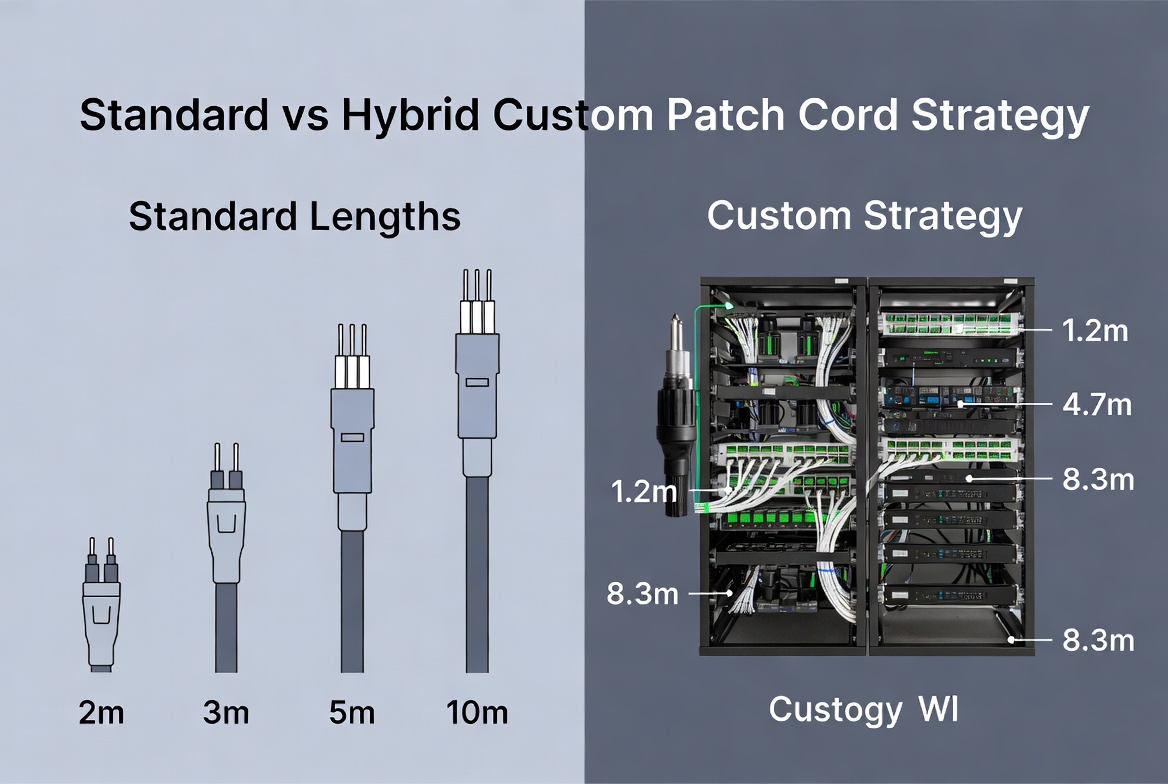
In real deployments, most organizations do not choose "only standard" or "only custom"—they adopt a hybrid strategy. [csustan]
- Standard lengths are ideal when:
- You are building conventional rows of racks.
- You need fast delivery and easy stocking.
- Cost optimization is important and lengths are not extremely critical. [csustan]
- Custom lengths make sense when:
- Your layout is unique or space‑constrained.
- You are deploying high‑density or high‑speed links where clean routing matters.
- You want long‑term visual order and simplified troubleshooting. [csustan]
For many customers, the optimal approach is: use standard 2m, 3m, 5m, 10m where they clearly fit, and design a limited set of custom lengths for the tricky segments. [csustan]
To make selection easier for engineers, buyers, and installers, we use a simple internal checklist when advising customers. [zhyuxun.en.alibaba]
Before you order, confirm:
1. Device locations – Are the ports in the same rack, adjacent racks, or across the room? [csustan]
2. Routing path – Top of rack, underfloor, or side management? [csustan]
3. Slack tolerance – Is there room for extra loops, or is the environment very dense? [csustan]
4. Bend constraints – Any tight corners or small enclosures? [csustan]
5. Growth plans – Will you add more equipment later that might change routing? [csustan]
If at least three answers point to "non‑standard" conditions, that's usually the signal to move from pure standard lengths to customized patch cords for at least part of the project. [csustan]
From a manufacturing and OEM/ODM standpoint, we see the downstream impact of length decisions across hundreds of customer projects. A poorly planned length strategy often leads to: [zhyuxun.en.alibaba]
- Repeated re‑ordering of "missing" lengths.
- Time‑consuming re‑routing or re‑labeling in live data centers.
- Cluttered racks, harder diagnostics, and higher risk of accidental disconnection.
By contrast, projects that spend time up front on length mapping and standard/custom planning typically enjoy:
- Lower total cost of ownership for cabling.
- Faster deployment and expansion.
- Cleaner, more compliant installations that impress end‑customers and auditors. [zhyuxun.en.alibaba]
As a high‑speed cable manufacturer, we frequently support customers by reviewing their layout drawings and suggesting an optimized length mix before they lock in orders. [zhyuxun.en.alibaba]
The higher your data rate, the more important every component becomes—including patch cord length. [csustan]
For 10G, 40G, and 100G optical links, installers pay close attention to:
- Total channel loss budget – Patch cords, pigtails, splices, and connectors all eat into the allowed dB loss. Keeping patch cords reasonably short helps preserve margin. [csustan]
- Modal dispersion and bandwidth – For multimode fibers (OM3/OM4), longer lengths and multiple connections can shorten the usable distance at higher speeds. [csustan]
- Return loss and reflections – Especially with APC connectors, correct lengths and proper routing help stabilize loss performance over time. [csustan]
In designs where the calculated loss is tight, our recommendation is to avoid over‑length patch cords and, if necessary, move to custom lengths that minimize unnecessary fiber in the link. [csustan]
Consider a 20‑rack data center row where each Top‑of‑Rack (ToR) switch connects back to a central patch panel. The horizontal distance between racks is consistent, but the panel is not centered.
A typical scenario:
- Racks 1–5 are close to the panel (2–3 m runs).
- Racks 6–10 are mid‑row (4–6 m runs).
- Racks 11–20 are far (7–9 m runs).
If you rely only on standard lengths, you may end up with:
- 3m cords that are slightly too long in the short segment, leaving loops.
- 5m cords that are barely enough for mid‑row racks with tight routing.
- 10m cords that introduce significant slack at the far end.
By analyzing the layout, many integrators choose:
- Standard 2m and 3m cords for racks 1–5. [csustan]
- A custom 4.5m or 5m cord spec for racks 6–10. [csustan]
- A mix of 8m or 9m custom cords for racks 11–20—rather than defaulting to 10m. [csustan]
This blended approach keeps patching fields clean and predictable while still controlling costs. [csustan]
Even experienced teams can fall into a few predictable traps. Based on project feedback and support cases, these are the issues we see most often: [zhyuxun.en.alibaba]
- "Longer is always safer" – Over‑ordering length leads to coils of unused cable that block views, restrict airflow, and complicate troubleshooting. [csustan]
- Ignoring bend radius – Using very short cords in cramped enclosures can force tight bends and cause intermittent errors that are hard to diagnose. [csustan]
- No length standardization plan – Buying random lengths for each project creates warehouses full of "almost right" cords that are rarely re‑used. [csustan]
- Underestimating future moves/adds/changes – Choosing lengths with no margin for re‑routing means any new device will require new cords instead of re‑using existing ones. [csustan]
A simple internal guideline like "no more than 20–30 cm of visible slack per cord" can help keep designs disciplined and repeatable. [csustan]
Working with a custom cable manufacturer gives you more than just non‑standard lengths; you also gain engineering support for your cabling strategy. Typical value‑added services include: [zhyuxun.en.alibaba]
- Reviewing network drawings and recommending standard/custom mixes by area. [zhyuxun.en.alibaba]
- Pre‑labeling cords by rack or device to simplify installation. [zhyuxun.en.alibaba]
- Manufacturing high‑speed rated assemblies that match your exact fibers, connectors, and jacket requirements. [zhyuxun.en.alibaba]
As an OEM/ODM partner focused on high‑speed transmission cables, we see our role as helping you translate network design into precise, manufacturable cable sets—including the right patch cord lengths for each environment. [zhyuxun.en.alibaba]

Below is a practical guide you can adapt to your own projects.
| Scenario | Typical Length Choice | Notes |
|---|---|---|
| Same rack, same vertical side | 1.5–2m (use 2m standard) (csustan) | Enough for routing via side managers without loops. (csustan) |
| Same row, adjacent racks | 3m standard (csustan) | Works for most ToR to ToR or ToR to panel links. (csustan) |
| Same row, 2–3 racks apart | 5m standard or 4–6m custom (csustan) | Choose custom if path is consistently mid‑length. (csustan) |
| Across room or between row ends | 10m standard or 8–10m custom (csustan) | Check tray path before finalizing. (csustan) |
| Non‑standard rooms or wall cabinets | Custom (measured per path) (csustan) | Important in small or irregular spaces. (csustan) |
Use this table as a starting point, then refine based on your actual route measurements and density requirements. [csustan]
If you are planning a new data center, upgrading to higher speeds, or struggling with messy patching, it is worth investing in a structured patch cord length strategy instead of buying ad‑hoc lengths. [zhyuxun.en.alibaba]
As a custom manufacturer of high‑speed transmission cables, assemblies, and network cabling, we can:
- Review your rack layouts and drawings.
- Recommend an optimized mix of 2m, 3m, 5m, 10m and custom lengths.
- Produce OEM/ODM patch cords that match your exact connectors, fiber types, and jackets. [zhyuxun.en.alibaba]
Reach out with your layout or BOM, and we will help you turn it into a clean, scalable patch cord length plan that supports your network for years. [zhyuxun.en.alibaba]
Q1: Is it a problem if my patch cord is longer than I really need?
A bit of extra length is acceptable, but large coils of unused fiber can block airflow, complicate maintenance, and, in extreme cases, contribute to bend‑related losses. It is better to choose a length that leaves only minimal, controlled slack. [csustan]
Q2: For a typical enterprise rack, should I prefer 2m or 3m cords?
If devices and panels are in the same rack and routed through side managers, 2m cords often work well. When paths are less direct or racks are deeper, 3m gives a safer margin without excessive slack. [csustan]
Q3: When do I really need custom‑length patch cords?
Custom lengths are most valuable when standard sizes repeatedly leave too much or too little slack, especially in dense racks, small enclosures, or performance‑critical high‑speed links. Projects with non‑standard room layouts or industrial environments are typical candidates. [csustan]
Q4: Does patch cord length affect optical power budget calculations?
Yes. Every additional meter introduces incremental attenuation based on the fiber type and wavelength. In high‑speed or long‑distance designs with tight power budgets, keeping patch cords reasonably short helps preserve margin. [csustan]
Q5: How should I plan for future expansion when choosing lengths?
Design for current routes but allow modest flexibility—avoid cords that are so tight any rerouting becomes impossible. At the same time, keep visible slack under control by standardizing a small set of lengths and using custom cords where paths are consistently unique. [csustan]
1. Zion Communication – “2m, 3m, 10m, or Custom? Complete Guide to Fiber Patch Cord Lengths” (original article used as primary reference and base structure). https://www.zion-communication.com/2m-3m-10m-or-Custom-Complete-Guide-to-Fiber-Patch-Cord-Lengths-id41424306.html
2. Zhuhai Yuxun Innovation Technology Co., Ltd. – Company overview and OEM/ODM capabilities for communication cables and assemblies. https://zhyuxun.en.alibaba.com
3. ISO/IEC 11801 – International standard for generic cabling in customer premises (referenced for typical patch cord length ranges in office/data center environments). https://www.iso.org/standard/73496.html
4. Google E‑E‑A‑T Guidance – Experience, Expertise, Authoritativeness, Trustworthiness best practices. https://www.boostability.com/resources/google-e-e-a-t-guide/
5. Long‑Form Content for SEO – Recommendations on structuring and optimizing long technical content for search engines. https://www.fastfwd.com/long-form-content-for-seo/


