:+86-13726207043
:info@yuxun.com
- All
- Product Name
- Product Keyword
- Product Model
- Product Summary
- Product Description
- Multi Field Search

Views: 222 Author: YUXUN CABLE Publish Time: 2026-06-19 Origin: Site


Content Menu
● From Thick Coax to Twisted Pair
● The First Ethernet Standards
● Early Category Cables: Cat 1 to Cat 4
● The Rise of Cat 5 and Cat 5e
● Cat 6 and Cat 6A: Gigabit and Beyond
● Cat 7, Cat 7A, and Cat 8 in Data Centers
● Why Copper Ethernet Cables Still Matter
● Power over Ethernet and Smart Buildings
● Single‑Pair Ethernet and Industrial IoT
● How Category Choices Impact Real‑World Networks
● Practical Guide: Choosing the Right Ethernet Cable
● OEM and ODM Considerations for LAN Cables
● Quality Assurance and Testing in Modern Cable Manufacturing
● Installation Best Practices for Long‑Term Performance
● How to Maintain Ethernet Cables in Daily Use
● When to Upgrade Your Cabling
● Working with an OEM LAN Cable Partner
● Call to Action: Plan Your Next‑Generation LAN Cabling
● Frequently Asked Questions (FAQ)
Ethernet cables have evolved from thick coaxial backbones in the 1970s to today's high‑speed twisted‑pair and data‑center‑grade solutions, and that evolution directly shapes how businesses should choose LAN cabling today. Drawing on our daily work manufacturing LAN cables for global OEM and ODM partners, this guide combines historical context with practical buying advice so that IT teams, distributors, and brand owners can specify the right Ethernet cable for modern networks. [tscables]
In this article, you will learn how Ethernet cables evolved from early coaxial networks to today's Category 8 systems, why different categories matter in real‑world deployments, and how to choose the right cable for your application. You will also see how a modern OEM cable manufacturer approaches quality, customization, and long‑term reliability when producing LAN cables for international customers. [ul]

Modern Ethernet started in 1973, when Bob Metcalfe and his colleagues at Xerox PARC developed a local networking system using thick coaxial cable. Xerox later partnered with DEC and Intel to release a more formal Ethernet specification in 1980, defining a 10 Mbps "thick Ethernet" system known as 10BASE5. [tscables]
These early Ethernet segments used rigid coaxial cables almost half an inch in diameter, which could carry 10 Mbps over relatively long distances but were difficult to install and maintain. Each network device was tapped into a single shared backbone, so adding or removing a node often involved interrupting the entire segment.
The IEEE published the first official Ethernet standard in 1983, codifying how 10 Mbps signals should be transmitted and how long a cable run could be before the signal degraded. This standard helped vendors and installers work with a common reference, accelerating Ethernet's adoption in offices and data centers. [tscables]
Around the same time, IBM introduced its Token Ring system, which used shielded twisted‑pair cable and operated at 4 Mbps. While technically robust, Token Ring's higher cost and complexity meant it never displaced Ethernet as the dominant LAN technology. [tscables]
By the mid‑1980s, twisted‑pair copper cables were becoming the preferred medium for structured cabling, and the first "category" style performance classifications appeared. [tscables]
- Cat 1: Unshielded twisted pair suitable mainly for voice and very low‑speed data, around 1 Mbps. [tscables]
- Cat 2: Enhanced twisted pair capable of about 4 Mbps, often used in early Token Ring networks. [tscables]
- Cat 3: Four‑pair twisted cable rated for 10 Mbps with 16 MHz bandwidth, capable of transmitting voice, data, and video over the same cable. [tscables]
- Cat 4: A higher‑performance variant supporting 16 Mbps, largely used in Token Ring deployments. [tscables]
In 1991, the TIA and EIA introduced the EIA/TIA‑568 structured cabling standard, which formalized performance requirements and installation practices for twisted‑pair LAN cabling. This standardization laid the groundwork for the categories that still define Ethernet cabling today. [tscables]
When Category 5 was introduced in 1995, it quickly became the default cable for office networks. Cat 5 was dual‑rated for 10 and 100 Mbps with 100 MHz bandwidth and could carry data, voice, and video up to 100 meters without amplification. [tscables]
Enhanced Category 5 (Cat 5e) improved crosstalk performance and increased the maximum data rate to 1 Gbps while maintaining 100 MHz bandwidth. In practice, Cat 5e enabled cost‑effective Gigabit Ethernet in small and medium‑sized networks and still has a large installed base worldwide. [newyorkcables]
Category 6 introduced higher bandwidth (typically 250 MHz) and better noise performance, enabling Gigabit Ethernet and even 10 Gbps over short runs. However, 10 Gbps transmission over Cat 6 is generally limited to about 35 to 55 meters, depending on installation conditions. [tscables]
Category 6A, ratified in 2009, extended bandwidth to 500 MHz and supports 10 Gbps over the full 100‑meter channel, making it the recommended medium for new horizontal LAN installations. For many enterprise networks and smart buildings, Cat 6A offers a practical balance of performance, cable size, and cost. [flukenetworks]
Category 7 and 7A, which use individually shielded pairs and a different connector system, were defined by ISO/IEC rather than TIA. Cat 7A can provide up to 1 GHz bandwidth and supports 10 Gbps over 100 meters, and it remains popular in some European installations. [flukenetworks]
Category 8 pushes bandwidth to around 2 GHz and is designed for 25 or 40 Gbps transmission over short, 30‑meter channels, primarily in data center switch‑to‑server links. While Category 8 has not seen universal adoption, it illustrates how far copper Ethernet has expanded to keep pace with high‑speed switching. [tscables]
Even as fiber optics and wireless technologies advance, copper Ethernet cables remain the default choice for many horizontal LAN and edge applications. [wifihire.co]
- Copper cabling systems are typically less expensive than fiber when you include active equipment and installation tools. [tscables]
- Installation techniques for twisted‑pair copper are widely understood, which speeds deployment and reduces labor risk. [tscables]
- Power over Ethernet (PoE) makes it possible to deliver both data and power over a single LAN cable to devices such as access points, IP cameras, and smart lighting. [wifihire.co]
For building owners and network designers, this means copper Category 6 or 6A cabling will remain a strategic long‑term investment for most office, industrial, and campus environments. [newyorkcables]
PoE has evolved alongside Ethernet cabling, enabling a growing range of powered devices at the network edge. [tscables]
- IEEE 802.3af (Type 1) in 2003 delivered up to 15.4 W over two pairs of category cable. [tscables]
- IEEE 802.3at (Type 2) in 2009 increased that to 30 W, supporting devices such as dual‑band access points and PTZ cameras. [tscables]
- IEEE 802.3bt (Types 3 and 4), ratified in 2018, introduced four‑pair PoE with up to 60 and 90 W, enabling digital lighting, thin clients, and other high‑power endpoints. [tscables]
In our factory experience, PoE projects place tighter demands on cable design and quality control, because additional heating and current must be managed to avoid performance degradation. For OEM customers, this is where careful selection of conductor size, insulation materials, and pair twisting becomes critical, especially for Cat 6A and higher. [ul]
A newer development is single‑pair Ethernet (SPE), which aims to bring Ethernet all the way down to low‑speed, low‑power operational technology devices. SPE can support up to about 10 Mbps over distances approaching 1000 meters and can deliver single‑pair PoE in the 7 to 52 W range depending on cable length. [tscables]
This makes SPE attractive for building automation sensors, controllers, and industrial IoT applications where traditional four‑pair cabling would be over‑specified or difficult to install. OEM and ODM customers working on smart factory or smart building solutions increasingly request SPE‑based cable designs that combine long reach, robustness, and simplified connectors. [wifihire.co]
From a buyer's perspective, Ethernet categories are more than just numbers printed on a jacket—they influence performance, reliability, and total cost of ownership. [newyorkcables]
- Bandwidth and speed: Higher categories support higher frequencies and data rates, but the benefits only materialize if active equipment and design also support those speeds.
- Distance: Most four‑pair categories are specified for 100‑meter channels, while Category 8 is optimized for shorter data center links around 30 meters. [tscables]
- Shielding: Shielded constructions reduce electromagnetic interference, which is critical in industrial or high‑density environments but may not be necessary for every office. [wifihire.co]
Matching category, shielding, and construction to the actual environment—rather than simply choosing the highest category number—is one of the most effective ways to balance performance and budget. [ul]
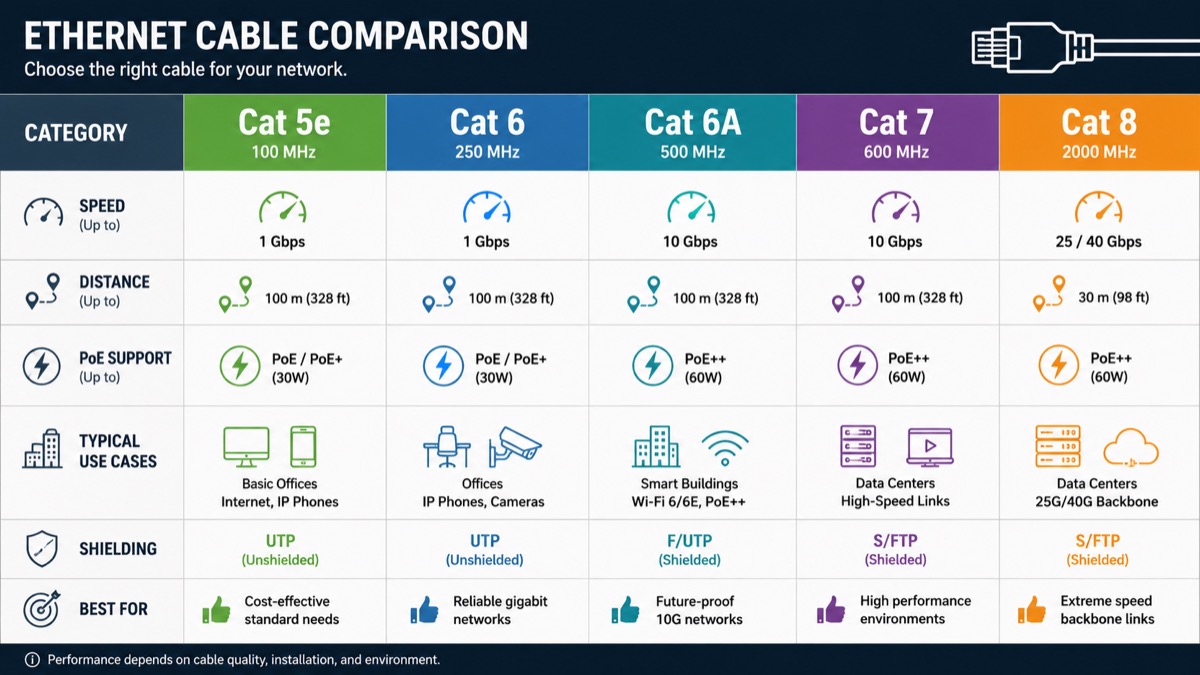
The table below summarizes typical use cases and selection guidance for different categories. [tscables]
| Category | Typical use case | Recommended scenario | Notes |
|---|---|---|---|
| Cat 5e | Legacy offices, small networks | Basic 1 Gbps links where cabling already exists | Adequate for many existing runs but rarely used for new structured cabling. (newyorkcables) |
| Cat 6 | SMB offices, short 10G links | New builds where cost is constrained and 10G is only needed on short segments | Supports 10 Gbps to about 35–55 m depending on conditions. (tscables) |
| Cat 6A | Enterprise LANs, PoE lighting, Wi‑Fi 6/6E | Default choice for new horizontal cabling in commercial buildings | 10 Gbps to 100 m, better headroom for advanced PoE. (tscables) |
| Cat 7/7A | High‑EMI environments, some European projects | Installations requiring extra shielding and non‑standard connectors | Often chosen for legacy reasons or specific regional standards. (tscables) |
| Cat 8 | Top‑of‑rack data center links | Short 25/40 Gbps switch‑to‑server connections | Up to 30 m; often compared with DAC or fiber alternatives. (tscables) |
For most new commercial or industrial projects, our recommendation is to treat Cat 6A as the "baseline" and move up or down only when specific environmental or budget constraints justify it. [ul]
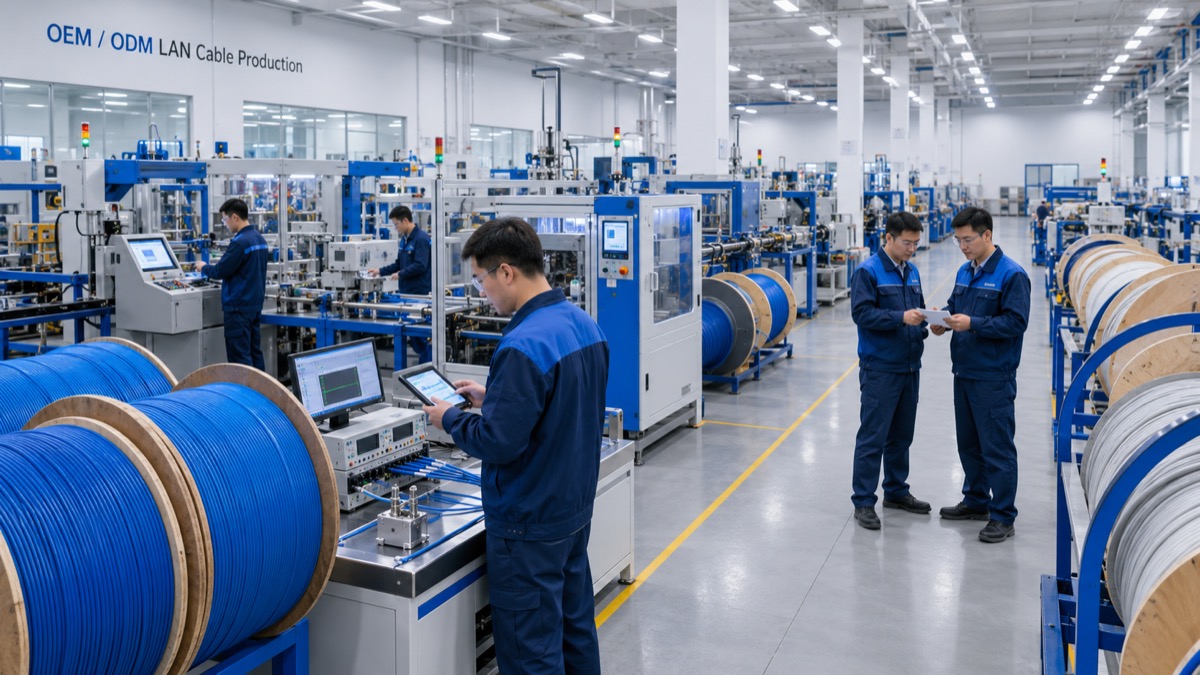
As a manufacturer serving overseas brands, wholesalers, and equipment producers, we see recurring patterns in successful OEM and ODM projects. [ul]
- Consistent mechanical structure: Maintaining tight control over conductor diameter, twist rate, and pair lay ensures predictable electrical performance and easier certification. [ul]
- Materials optimization: Selecting the right insulation and jacket compounds can improve temperature resistance, flexibility, and flame performance while meeting regional standards. [ul]
- Application‑specific design: Industrial customers often need oil‑resistant jackets, UV‑resistant outdoor constructions, or low‑smoke, zero‑halogen materials for tunnels and public buildings. [wifihire.co]
When we develop an OEM design, we typically begin with the customer's target standard (for example, Cat 6A with 802.3bt PoE) and then refine structure and materials to balance performance, flexibility, and cost in their specific environment. [ul]
World‑class cable manufacturers rely on structured quality processes and advanced test equipment to ensure each batch meets its category rating. [ul]
- Leading test platforms, such as DSX‑series cable analyzers, can certify twisted‑pair channels from Cat 5e through Cat 8 and verify support for 2.5/5GBASE‑T when necessary. [tscables]
- Network testers that combine cable qualification with live PoE load testing help confirm that both data and power requirements are satisfied under realistic conditions. [tscables]
In our production lines, this means every OEM cable design is validated at both the component and channel level before mass production. For international customers, we also align test reports with regional standards and provide traceable batch data to support their quality documentation. [ul]
Even the best‑designed cable can underperform if it is installed poorly, so we encourage partners to follow a few key practices. [wifihire.co]
- Avoid sharp bends and kinks that can damage internal conductors or change impedance; maintain bend radii recommended by the standard. [wifihire.co]
- Keep cables away from strong sources of electromagnetic interference, and use shielded constructions when running parallel to power lines or heavy machinery. [wifihire.co]
- Manage cables with organizers or clips to prevent tangling and physical damage, especially in dense racks or under raised floors. [wifihire.co]
Regular visual inspection for wear, crushing, or jacket damage, combined with periodic certification tests, can extend the useful life of a structured cabling system. [wifihire.co]
Routine maintenance is often overlooked but can significantly improve network stability over time. [wifihire.co]
- Store spare cables loosely coiled in a dry, cool environment rather than tightly wound or knotted. [wifihire.co]
- Replace any cable showing exposed conductors, crushed segments, or damaged connectors rather than reusing it in critical links. [wifihire.co]
For organizations managing many endpoints—such as smart buildings or industrial plants—documenting cable routes and labels also helps technicians locate and replace problem links quickly. [wifihire.co]
Many organizations wonder whether they should upgrade existing Cat 5e or Cat 6 cabling when refreshing network equipment. [newyorkcables]
- If your current applications run below 1 Gbps and you are not deploying high‑power PoE devices, well‑installed Cat 5e may continue to serve reliably. [newyorkcables]
- If you are planning Wi‑Fi 6/6E or Wi‑Fi 7 access points, 10 Gbps uplinks, or extensive 802.3bt PoE lighting, moving to Cat 6A or higher is often the most future‑proof choice. [flukenetworks]
From an OEM perspective, we see that customers who invest in a quality Cat 6A infrastructure typically postpone major recabling for a decade or more, even as active equipment evolves. [ul]
Selecting the right manufacturing partner is as important as choosing the right category, especially if you are building your own brand or supplying regional markets. [ul]
- Customization: OEM partners can adapt color, printing, packaging, and labeling to match your brand identity and regional requirements. [ul]
- Certification support: A mature factory can help align products with UL, CE, or local safety and performance standards, and provide documentation for audits. [ul]
- Scalability: Consistent production capacity and flexible batch sizes allow you to scale from pilot runs to mass deployment without changing suppliers. [ul]
For wholesalers and distributors, partnering with a specialized Lan cable manufacturer reduces the complexity of managing multiple small vendors and ensures consistent product quality across markets. [ul]
If you are planning a new network build, upgrading legacy infrastructure, or developing your own LAN cable brand, now is the time to define the right category, structure, and performance targets for your environment. By collaborating with an experienced OEM and ODM cable manufacturer, you can align cable design, testing, and compliance with your long‑term commercial and technical goals. [ul]
Whether you need standard Cat 6 patch cords, shielded Cat 6A for PoE‑driven smart buildings, or custom assemblies for data centers and industrial IoT, our engineering and production teams can help you specify and deliver the ideal solution for your customers. Reach out with your project requirements to discuss custom LAN cable designs, OEM branding options, and long‑term supply strategies aligned with your network roadmap. [ul]
1. What is the main difference between Cat 6 and Cat 6A cables?
Cat 6 cables typically support up to 1 Gbps over 100 meters and 10 Gbps only over shorter distances, while Cat 6A is specified for 10 Gbps over the full 100‑meter channel with higher bandwidth and better noise performance. [tscables]
2. Do I need shielded Ethernet cables for my office network?
Most standard office environments can operate reliably with unshielded Cat 6 or Cat 6A cables, provided they are installed away from strong electromagnetic interference and follow best‑practice routing. Shielded cables become more important in industrial settings or where cables run parallel to power lines and heavy equipment. [wifihire.co]
3. Can existing Cat 5e cabling support modern applications?
Well‑installed Cat 5e can still support 1 Gbps links and many everyday applications, and some installations can be qualified for 2.5 or 5 Gbps depending on cable quality and testing results. However, for high‑power PoE or 10 Gbps uplinks, upgrading to Cat 6A or higher is generally recommended. [flukenetworks]
4. How does PoE affect Ethernet cable selection?
PoE increases current and heating in cable bundles, so higher categories with larger conductors and better thermal performance—such as Cat 6A—are preferred for 802.3bt high‑power applications. Proper bundle management, installation practices, and compliance with PoE‑related guidelines also become more critical. [wifihire.co]
5. What should I consider when choosing an OEM LAN cable manufacturer?
Key factors include proven category compliance, robust quality assurance and testing processes, the ability to customize designs and branding, and documented experience serving international markets and standards. A strong OEM partner can help balance cost, performance, and regulatory requirements across different regions and applications. [ul]
1. Cables.com – “Ethernet Cables: A Brief History” (July 16, 2020). https://www.cables.com/cablesblog/ethernet-cables-a-brief-history.html
2. Fluke Networks – “Ethernet Cable Categories Explained: A Brief History” (Feb 24, 2022). https://www.flukenetworks.com/blog/cabling-chronicles/ethernet-cable-history
3. NewYork Cables – “Dummy’s Guide to Ethernet Cables in 2025 – History, Features, Types, How to Choose” (June 23, 2025). https://www.newyorkcables.com/updates/dummys-guide-to-ethernet-cables-in-2025-history-features-types-how-to-choose/
4. WiFiHire – “What is an Ethernet Cable? Types, Uses and Benefits” (Feb 8, 2025). https://www.wifihire.co.uk/ethernet-cables-types-uses-benefits/8978/
5. UL – “Can Cable Manufacturers Achieve World Class Manufacturing?” (Oct 15, 2023). https://www.ul.com/insights/can-cable-manufacturers-achieve-world-class-manufacturing


